
The BOJ's biggest hike since 1995 barely moved the yen
The yen sits near a 40-year low even after Japan's largest rate hike since 1995 and record intervention. This is what actually moves a major currency.
By the Deriv desk · 6 July 2026 · 3 min read

A single big policy action rarely turns a currency. The yen sits near a 40-year low even after the Bank of Japan's largest rate hike since 1995 and record intervention, because what moves a major currency is the persistent gap between what it pays to hold and what the alternative pays.
Japan has pulled its two biggest levers. Rates are at their highest since 1995. Officials spent a record sum defending the currency in the spring. And still, USD/JPY trades near its weakest level since 1986.
Why a rate hike alone doesn't move a currency
A currency is a relative bet. You are always holding one against another. So the figure that matters is not Japan's rate on its own. It is the gap between what dollar assets pay and what yen assets pay.
That gap is still wide, around three percentage points in the dollar's favour. The Bank of Japan lifted its benchmark to 1%. The US sits far above it. Until that distance narrows, holding dollar assets pays more than holding yen ones.
The hike was real, but it barely dented the incentive to sell yen. A big headline moved the level for a moment. The structural pull stayed in place.
The carry trade: the demand that keeps the yen weak
Cheap yen has a second job. For years, traders have borrowed in yen at low cost and parked the proceeds in higher-yielding assets elsewhere. That is the carry trade, and it needs a steady supply of sellers.
As long as the rate gap holds, that demand to sell yen renews itself. It is a current running under the price, not a one-off event. Policy headlines fight against it. They rarely reverse it.
What record intervention actually buys
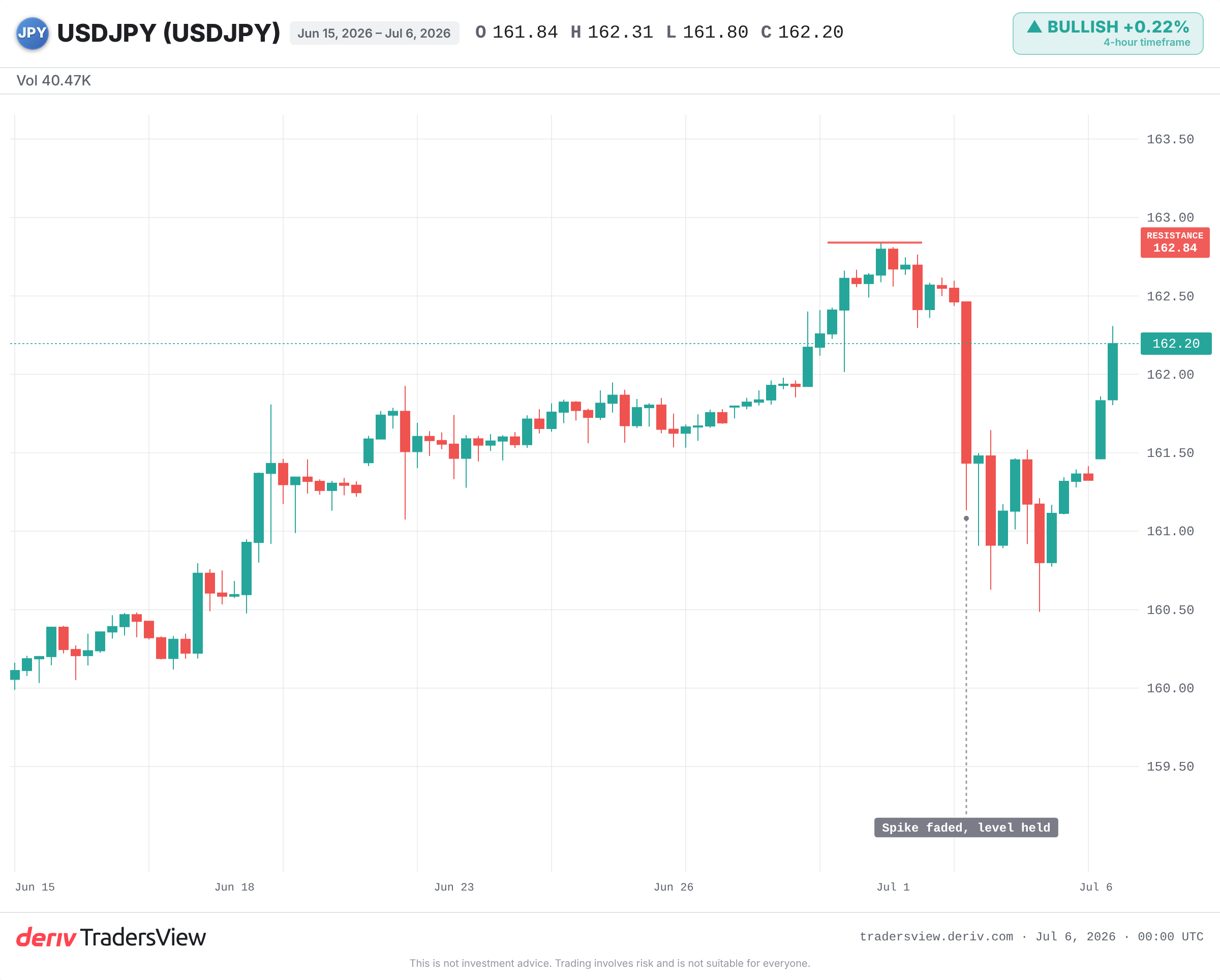
Japan spent roughly $72.5 billion defending the yen across April and May, a record. A suspected intervention early this month knocked the pair down about 100 pips in minutes. Within hours it was back near where it started.
Intervention buys time, not a trend. The 2022 episode showed the pattern: sharp spikes, then a drift back, with the durable turn arriving only later when US rate-cut expectations narrowed the gap. Reserves of about $1.1 trillion are a large war chest, but they push against the tide rather than turn it.

The crowded trade and the risk of a snap-back
The obvious read is that the trend is one-way. The stronger point is that everyone is already leaning the same way. Futures show a large net short position against the yen.
That is exactly the setup for a violent reversal. In August 2024, a BOJ hike forced a rapid unwind of the carry trade. The yen surged, and the S&P 500 slumped for three straight sessions as leveraged positions scrambled to cover.
A softer US jobs print already pulled the pair off its high this month. If US data keeps cooling and the Fed moves towards cuts, the rate gap narrows and crowded shorts have to buy back yen fast.
What to watch from here
- The US-Japan rate differential: any Fed cut or further BOJ move is what genuinely shifts the trend.
- Confirmed intervention with follow-through, not just verbal warnings.
- Whether the pair breaks and holds above its recent 40-year high, or keeps getting rejected there.
- Extreme short positioning unwinding, which could turn a small move into a self-feeding rally.
The lesson outlasts this week. Watch the gap, not the headline. A currency turns when the forces holding it in place shift, and no single announcement is usually enough to do that on its own.
Frequently asked questions
It is borrowing yen at low interest rates and investing the proceeds in higher-yielding assets elsewhere. The strategy relies on a wide gap between Japanese and foreign rates, and it creates steady demand to sell yen.
History suggests not on its own. Intervention tends to produce sharp but temporary spikes. A durable turn usually needs the underlying rate differential to narrow, as happened after Japan's 2022 interventions.
A decisive narrowing of the US-Japan rate gap, most likely from softer US data pushing the Fed towards cuts, combined with sustained intervention. Extreme short positioning could then amplify any move as traders rush to cover.
Because the carry trade links them. When the yen surges suddenly, leveraged positions funded in yen can be forced to unwind, spilling into other assets. In August 2024, one such unwind coincided with a multi-day slump in the S&P 500.