
Why Do Gold and Bitcoin Sometimes Fall Together, Then Break Apart?
A strong dollar can drag gold and Bitcoin down at once. Here is why one macro force overrides each asset's own story, and when one breaks away.
By the Deriv desk · 26 June 2026 · 4 min read

When one macro force gets big enough, it drags unrelated assets down together. An asset only breaks ranks when it has a stronger story of its own.
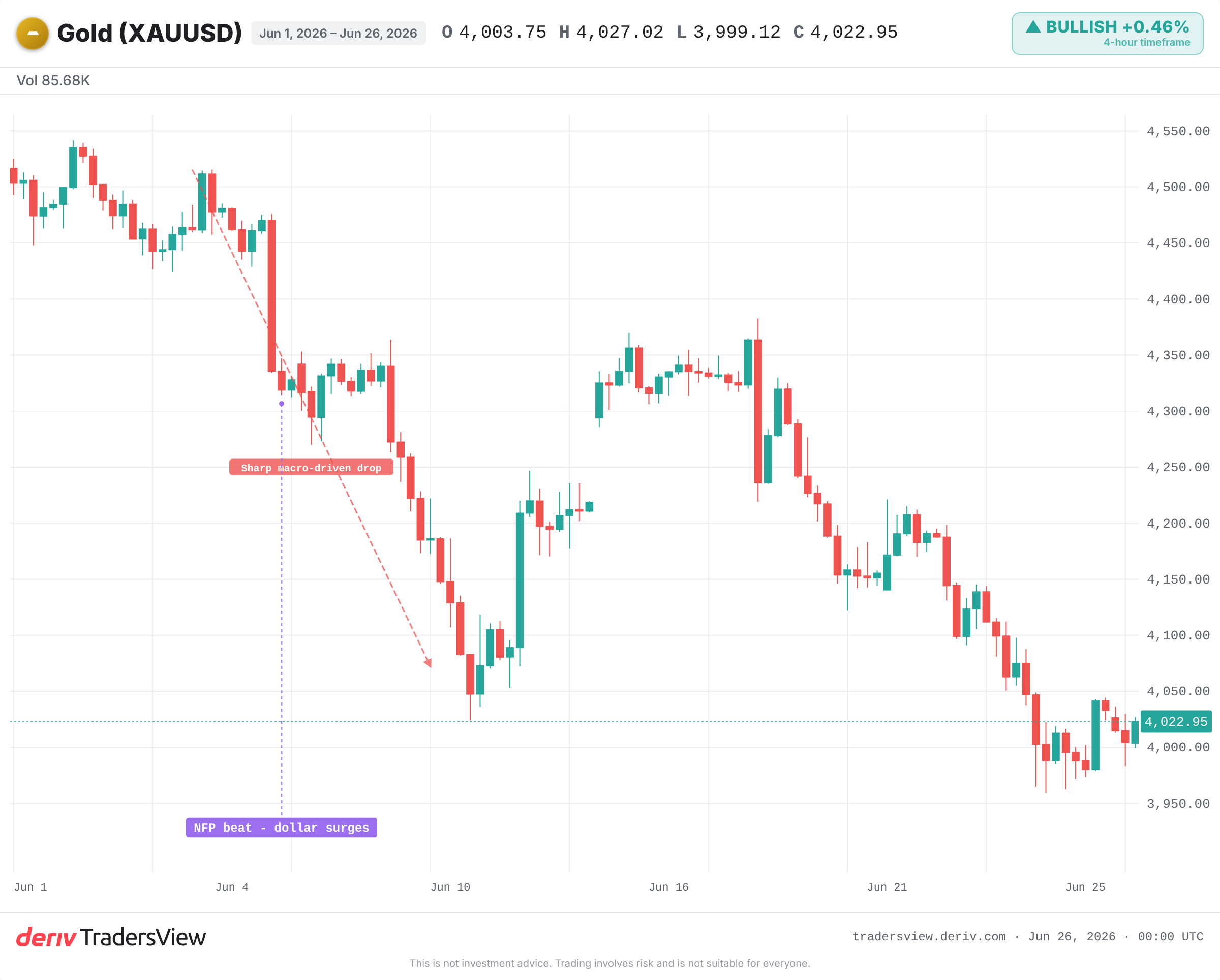
In June 2026 gold and Bitcoin fell at the same time. That looks odd. They are usually pitched as rivals, two different ways to bet against paper money. So why did they move in lockstep?
The answer is the dollar and the price of money. A strong dollar and renewed rate-hike fears hit every hedge at once. When that single force is loud enough, it drowns out each asset's own story. For a while, nothing else matters.
Why a strong dollar hits gold and Bitcoin at the same time
Neither gold nor Bitcoin pays interest. So the cost of holding them rises when rates rise and the dollar strengthens. Cash starts to look more attractive. Money you could earn elsewhere is money you give up by sitting in a non-yielding asset.
When the cost of money climbs, every asset that pays you nothing gets repriced together. It does not care whether the asset is a 5,000-year-old metal or a 17-year-old token. The same lever moves them both.
We saw a sharper version of this in March 2020. Gold, Bitcoin, stocks and even US Treasuries sold off together. Margin calls forced traders to dump anything liquid in a dash for cash. For those days, correlation across unrelated assets shot toward one.
The correlation trap: who is really in charge
A day when everything drops at once is telling you something. It is naming the force in charge. In June 2026, that force was the dollar and rate expectations, not anything specific to gold or crypto.
This is the trap. Investors hold gold and Bitcoin as different bets, expecting them to behave differently. Then a big macro shock arrives and the diversification vanishes exactly when it was needed. The assets were never as independent as the story claimed, at least not under stress.
How to tell when one asset is about to break away
The lockstep does not last. An asset breaks ranks when its own driver gets stronger than the macro force pinning it down.
Look at 2022. Rising real yields and a surging dollar pressured gold and Bitcoin together. Then rate-hike expectations peaked. Gold stabilised and recovered. Bitcoin kept falling, dragged down by its own crisis, the FTX collapse. Same macro relief, two different outcomes, because each asset had its own dominant story underneath.
By 2024 and 2025, per CME Group analysis, the two had decoupled outright. Gold rose on central-bank buying and geopolitical demand. Bitcoin traded more like a risk asset. Their correlation is regime-dependent: together under a shared shock, apart when each follows its own idea.
What to watch from here
The honest read: the June 2026 fall looks like the exception, not a new rule that gold and Bitcoin are now the same trade. The shared drop came from a strong dollar and a temporary scramble for cash. Ease that pressure and the two should resume diverging.
- The dollar's direction. A peaking dollar would relieve both assets at once.
- Rate-hike expectations and Fed commentary. The tightening fear is the glue holding the two together.
- Forced selling. Correlation spiking toward one across unrelated assets is the tell.
- A central-bank bid for gold. If gold finds a floor Bitcoin lacks, the shared move is breaking.
- Crypto liquidity stress. It could keep Bitcoin falling after gold has steadied.
The point holds beyond this episode. When unrelated assets fall together, find the force in charge first. Then ask which asset has a story strong enough to break away.
Frequently asked questions
Their correlation is regime-dependent. They tend to fall together under a shared macro shock like a strong dollar or a cash scramble, but trade apart when each follows its own driver. CME Group analysis showed the two decoupling across 2024 and 2025.
Holding an asset that pays no interest costs you the return you could have earned elsewhere. When rates rise, that opportunity cost climbs, so investors reprice gold, Bitcoin and similar assets lower at the same time.
It is when investors sell whatever is liquid to raise cash, often forced by margin calls. In March 2020 this pushed gold, Bitcoin, stocks and even Treasuries down together for several days.
Not necessarily. A shared fall under dollar pressure is usually temporary. Gold can find a separate bid from central-bank buying that Bitcoin lacks, which is one sign the assets are about to move apart again.