
Why Bitcoin lags its debt-hedge case
US debt tops $39 trillion, the core case for Bitcoin as a hedge. Yet the price sits near half its peak. A strong thesis and a weak market both hold.
By the Deriv desk · 27 July 2026 · 3 min read

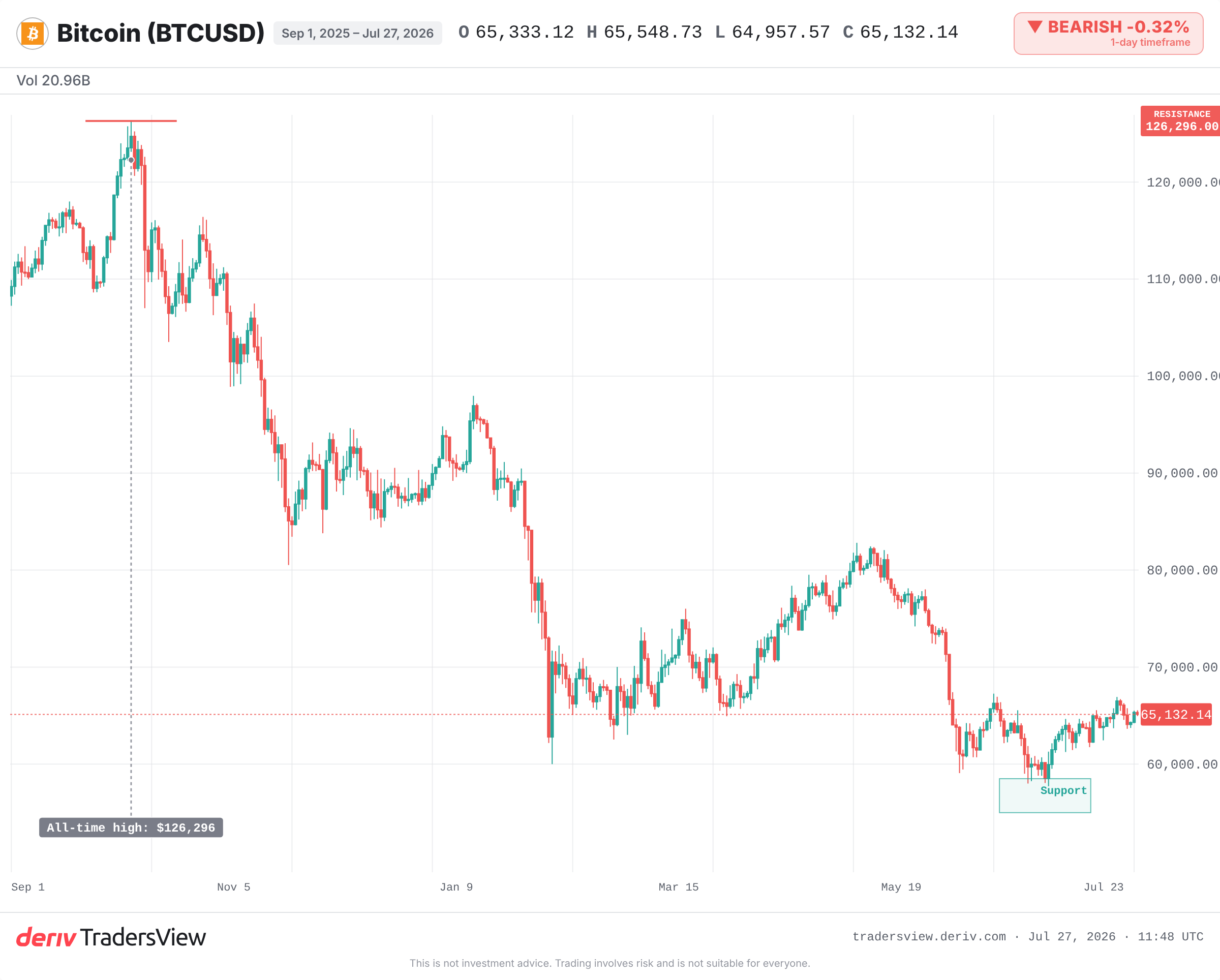
Why you own an asset for years and why it moves this month are two different questions. Bitcoin shows this clearly right now. US debt keeps hitting new records. That is the whole argument for owning Bitcoin as a hedge against a weakening dollar. Yet Bitcoin trades near $65,000, about half its late-2025 peak. Short-term flows point the other way. Both things are true at once.
The debt number behind the debasement trade
US federal debt has passed $39 trillion. It climbs by billions a day. The idea is simple: if a government borrows without limit, the currency loses value, so hold scarce assets instead.
Robert Kiyosaki, author of Rich Dad Poor Dad, is the loudest voice for this view. He says he has held gold since 1971 and Bitcoin since 2012. The long-run case is genuinely strong. It just does not tell you what Bitcoin does this quarter.
Why a strong thesis can sit next to a falling price
The reason to hold an asset for five years and the reason it moves this month rarely match. Debt is a slow force. It builds over years. Price is set by fast flows: who is buying, who is selling, and how much borrowed money is in the market right now.
Lately the flows point down. BlackRock's spot Bitcoin fund saw clients pull money out after buying days earlier. Some betting markets leaned towards a further drop before year-end. Debt kept rising through all of it. The big-picture story and the price were pulling in opposite directions.
Bitcoin still trades like a risk asset, not a safe haven
This is the hard truth for the hedge crowd. If rising debt really set Bitcoin's price, it would not be near half its peak while debt hits records. Bitcoin acts like a risk asset. It rises when money is easy to borrow and falls when investors get nervous. A true safe haven does the opposite.
The past rhymes here. During the pandemic, huge government spending lined up with Bitcoin's run to record highs. The debasement story became gospel. Then Bitcoin fell around 75% into late 2022, even as debt kept climbing. The story did not set the price.
Gold in 2011 tells the same story
In August 2011, the S&P downgraded US debt for the first time. Gold, the classic debasement hedge, jumped to records. Then it peaked within weeks and fell for years, while debt kept rising the whole time. A hedge and its trigger can split apart for years.
That is the lesson worth keeping. A rising long-run driver can justify owning an asset for years, while short-term buying and selling drag the price the other way.
What to watch next
The two ideas play out over different timeframes, so watch different signals for each:
- Flows: whether fund selling keeps going or turns to buying. That decides the near-term price.
- Levels: whether Bitcoin holds the mid-$50,000s that markets have been pricing a break below.
- Liquidity: Federal Reserve policy. Rate cuts make money easier and help risk assets. Higher rates for longer squeeze them.
- Confirmation: a return to the 2025 high would be the first real sign the long-run case is finally showing up in price.
For now the evidence leans one way. Positioning and liquidity, not the debt story, are driving the price this quarter. The long-run case can still be right. It is just running on a slower clock. The skill is holding both ideas without flipping between them. Trading is risky, and a strong long-run view is no guard against a sharp near-term drop.
Frequently asked questions
The long-run case rests on Bitcoin's fixed supply against ever-rising government debt. In practice it has traded more like a risk asset, rising and falling with market liquidity rather than reliably rising when currencies weaken. It may hedge debasement over years while failing to protect you in any given month.
Debasement is the loss of a currency's purchasing power over time, often blamed on heavy government borrowing and money creation. The idea is that as more currency chases the same goods, each unit buys less, pushing some investors towards scarce assets like gold or Bitcoin.
Spot Bitcoin ETFs channel large institutional money in and out of the market. Sustained inflows add buying pressure, while outflows signal selling. Because these funds now hold significant supply, their daily flows are one of the clearer short-term signals of institutional appetite.
Debt moves slowly and structurally; price is set by fast-moving flows, leverage and sentiment. A rising debt load can support the long-term case for owning Bitcoin even as short-term positioning and risk-off selling drag the price lower at the same time.