
When a rival goes public, everyone else has to answer
SpaceX's listing put a public price on the space race and reportedly pushed Bezos to raise for Blue Origin. Why the newly listed stock splits analysts.
By the Deriv desk · 15 July 2026 · 3 min read

A rival's public valuation acts like a starting gun: it puts a visible price on a whole industry and forces competitors to react. SpaceX's June listing did exactly that, and it is reportedly what pushed Jeff Bezos to raise fresh capital for Blue Origin now.
The listing set a number the private-space race could no longer ignore. Once one player is priced in public, everyone nearby has to justify or chase that figure.

How one IPO sets the price for an entire industry
Before a listing, a private company's worth is a matter of opinion. After it, there is a live number on a screen. That number becomes the benchmark rivals are measured against, whether they like it or not.
This is not new. Facebook's 2012 IPO set a public price for social media and pressured private peers to justify their own valuations. Google's 2004 listing did the same for search, pulling capital towards the theme and pushing competitors to accelerate their own bets.
A rival's public price resets expectations for the whole field, and capital tends to follow the theme. That is the logic behind Bezos raising now rather than later. The scoreboard just lit up, and Blue Origin needs to answer it.
Why the newly listed stock becomes a battleground
The benchmark exists, but the market cannot agree on what it means.
SpaceX shares trade near their all-time low, well below the record high set earlier. The gap to that record low is less than one typical daily swing away. Yet analyst price targets span an enormous range, from the low hundreds to roughly $800.
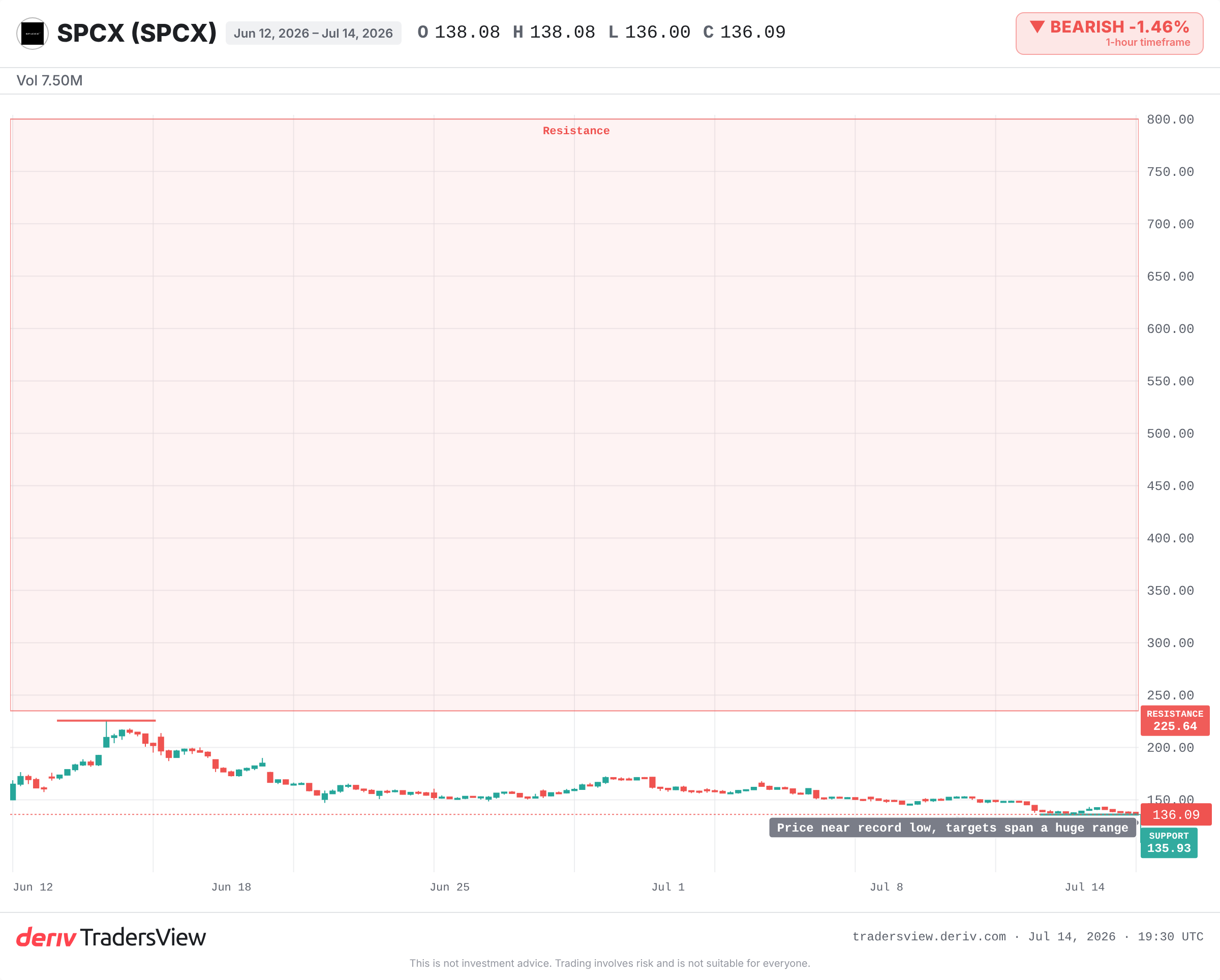
When professionals price the same stock across a spread that wide, they are not valuing a business, they are guessing at a narrative. A frontier company has little earnings history to anchor to. So the targets reflect competing stories, not shared conviction.
Does a stock near its low mean a bargain?
The obvious read is that a rival's raise forces competitors to act and a stock at record lows is cheap. The stronger opposing case is less comforting.
The slide has coincided with insider lockup expirations, when early holders are first allowed to sell. Fresh sellable supply hitting the market can pin a price low regardless of the story. Add a string of Congressional purchase disclosures and a record-high target issued in the same week shares slid, and you get noise, not a signal.
The space SPAC wave of 2019 and 2020 is the cautionary example. Names like Virgin Galactic swung wildly on narrative and analyst disagreement rather than earnings. Many round-tripped huge gains, rewarding patience over the listing-week frenzy.
What to watch next
The evidence leans towards caution over the bargain read, at least until the supply picture clears. A few concrete markers matter more than the headlines:
- A decisive break below the all-time low on rising volume, with no fundamental catalyst, would validate the bearish case.
- Further insider lockup expirations adding sellable supply.
- Confirmation or denial of the Blue Origin fundraising round that anchors the whole story.
- New analyst initiations widening or narrowing that target spread.
A listing can set the price for an industry. It cannot tell you what any single stock is worth in its first volatile months. Trading a newly public frontier name carries real risk, and early volatility rarely decides the long-run outcome.
Frequently asked questions
A lockup is a period after an IPO when early investors and insiders cannot sell their shares. When it expires, that supply can hit the market, which often pressures the price lower regardless of how the business is performing.
A newly public company, especially in a frontier sector, has little earnings history to value against. Analysts anchor to competing stories about the future instead, so their targets can diverge dramatically.
No. Blue Origin is privately held by Jeff Bezos. Reporting suggests it is raising fresh capital privately, reportedly prompted by a rival's public listing setting a visible valuation benchmark.
Not always, but a visible public price often pressures private rivals to justify or chase that valuation, and it tends to pull investor capital towards the theme. Whether a specific competitor raises depends on its own funding needs and timing.