
The hyped IPO trap: why day one is often the worst price
Anthropic may file to go public soon. SpaceX shows why the opening day of a hyped IPO is often the worst entry, and what to read instead of the raise.
By the Deriv desk · 24 August 2026 · 4 min read

Getting in early is not the same as getting in cheap. The day a hot IPO opens is the day its story meets the scoreboard, and the most-hyped debuts are often where hope and price split fastest.
Anthropic is reportedly preparing to file for a public listing within weeks, chasing SpaceX's record raise. For the first time, ordinary investors could buy a leading AI company directly. That is the appeal. Here is the catch.
What SpaceX shows about record-setting debuts
SpaceX went public earlier this year in the biggest raise on record. It now trades around $134, roughly 40% below its post-IPO high near $226. A landmark debut, and it still round-tripped once the initial excitement faded.
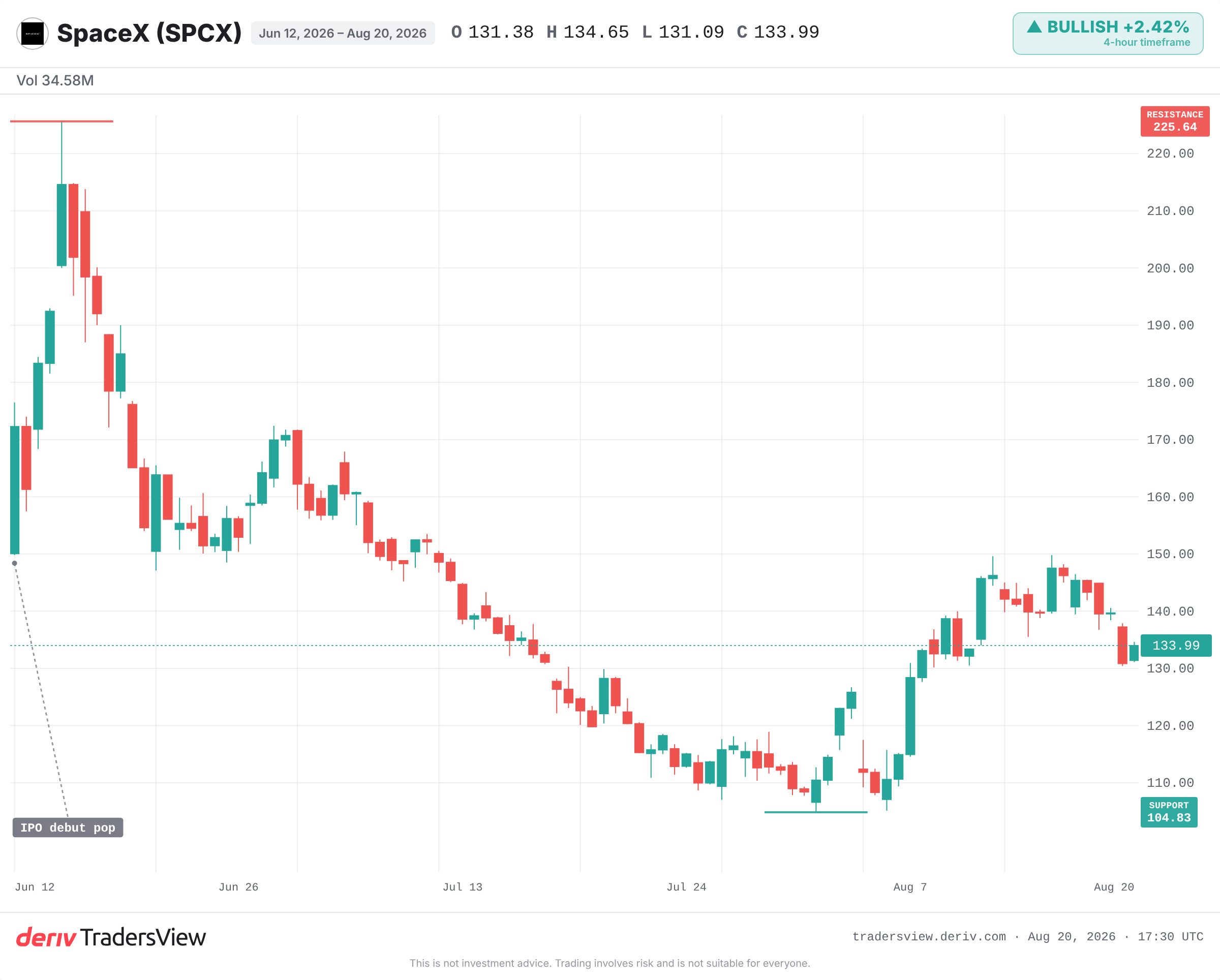
The daily swings tell the same story. This is a stock that can move more than $11 in a single session. Early public prices are volatile because the market is still arguing over what the company is worth. A blockbuster IPO is an entry point, not a guarantee.
Why the first-day pop rarely helps retail buyers
The pattern repeats across the last decade of hyped listings. In December 2020, Airbnb and DoorDash more than doubled on their first trading day. That reward went to insiders holding allocated shares, not to buyers chasing at the open. Both later gave back large chunks of those gains.
Uber priced at $45 in May 2019, fell on debut, and traded below its listing price for over a year. Rivian listed in November 2021 at a valuation above legacy carmakers with almost no revenue, then lost more than 80% as production and losses caught up. The open is frequently the worst price a public buyer will see for a long time.
The offering price and the opening price are not the same
Two prices sit behind every debut, and the gap between them is the whole problem. The offering price is set the night before by the company and its banks. It is the price allocated buyers pay before trading starts.
The opening price is what the first public trade prints the next morning, once demand meets a limited float. When a listing is hot, that first print can sit far above the offering price. Allocated holders capture the jump. A retail buyer at the open pays the marked-up price and inherits the downside. The pop rewards whoever got in before the market opened, not after.
How to read the prospectus, not the raise
Skip the raise size on the front page and go straight to four numbers in the S-1. Find the fully diluted share count and multiply it by the offering price to get the real valuation. Divide that by trailing revenue to see the price-to-sales multiple you are paying. Then read the operating figures to see whether losses are widening or narrowing, and check the lock-up terms for when insider shares can hit the market.
Anthropic's growth is real: reported preliminary revenue above $11.5 billion and a run rate that reportedly jumped sevenfold over the year. But it also reportedly posted a net loss near $1 billion in 2025. The question is whether that revenue converts into durable margins before rivals with equally deep pockets catch up. An extreme price-to-sales multiple leaves little room for a stumble.
The bull case, and what would prove it right
The other side is worth stating plainly. AI may be a genuinely new platform, and the leaders could compound revenue for years. Sceptics who dismissed the early Amazon and Google listings missed enormous returns. Paying up now could look cheap later.
That case holds if Anthropic turns its run rate into real margins and defends its position. It fails if the stock is priced for perfection and the growth wavers. SpaceX is the live proxy: watch how the market treats a record AI debut once the pop wears off.
None of this is a call to buy or avoid. It is a reminder that excitement and price are different things, and the gap between them is widest on day one.
Frequently asked questions
Usually not. The IPO price goes to institutions and allocated insiders. Ordinary investors typically buy once shares open for public trading, which is often well above the listing price on hyped deals.
A lock-up bars insiders from selling their shares for a set period after listing, often 90 to 180 days. When it expires, a wave of insider selling can pressure the price, so it is worth knowing the expiry date before buying.
It compares a company's market value to its annual revenue. A very high multiple means investors are paying a lot for each dollar of sales, which leaves little room for disappointment if growth slows.
In the prospectus, known as the S-1 in the US. It lists revenue, losses, share count, valuation and risk factors. It is the primary source for judging a listing beyond the headline raise.