
Silver's $62 jobs-day spike: reversal or just a bounce?
Silver jumped above $62 after a weak US jobs report, but stays below key averages inside a downtrend. Why the $62.13 level, not the headline, decides.
By the Deriv desk · 6 July 2026 · 3 min read

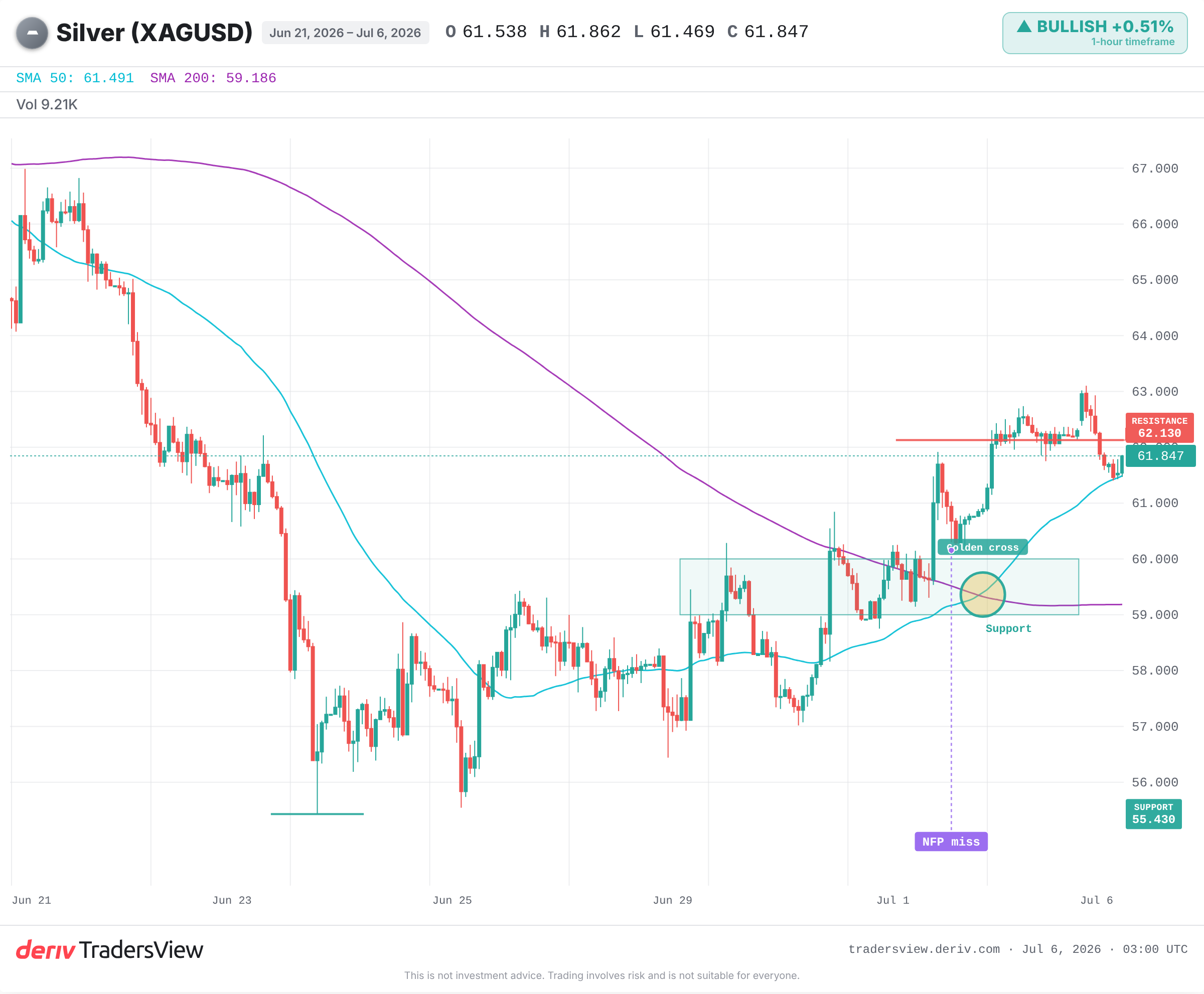
A weak US jobs report lifted silver above $62, but the metal is still trading below its key moving averages inside a downtrend. Until a level holds, that spike reads as a correction, not a turn.
Silver jumped on July 3 after June payrolls came in at just 57,000, far below hopes. Soft jobs data revives bets on Federal Reserve rate cuts, and lower rates tend to help metals that pay no yield. The headline gave silver its spark. Whether the fire catches is a separate question.
Why a news spike is not the same as a trend change
News moves price. The trend and the levels decide whether the move sticks. Silver had already fallen to a six-month low near $55.60 on June 26 as a hawkish Fed repricing and a firmer dollar dragged it down. The July bounce reversed part of that drop. It did not reverse the structure behind it.
A rally inside a downtrend is a correction until it proves otherwise. Price is still sitting below the moving averages that framed the recent decline. That is the difference between a bounce and a bottom.
The one level that matters right now
Silver is pressing against resistance near $62.13, the 38.2% Fibonacci retracement of the earlier fall. As of the latest read, spot trades just under it, around $61.86. What happens at that line tells you more than the payroll headline that got price there.
A decisive close above $62.13 would open the door towards the $63.56 to $64.11 band, then higher. A rejection points back to the $59 to $60 support cluster. A break below $58.50 would invalidate the bullish setup and put the $55.60 low back in play.
What the past teaches about jobs-day rallies
Weak US jobs prints spark sharp metal rallies often. Many fade within days when the broader rate and dollar trend stays intact. In 2011, silver's post-peak bounces were repeatedly sold as a multi-year downtrend reasserted itself.
2020 was different. Silver's violent rebound held because it lined up with a genuine regime shift: mass stimulus and a real easing cycle. That is the test. A correction fails at resistance. A reversal is confirmed by the trend turning and the levels holding.
The bull case, and what would confirm it
The stronger opposing view is regime change. Silver is still up roughly 68% over the past year, even after slipping around 12% year to date. If soft jobs data marks the start of a real Fed easing cycle, the June low near $55.60 could be a durable bottom, and the current bearish structure the tail end of a shakeout.
The confirmation is mechanical, not emotional: a clean close above $62.13, then follow-through into $63.56 to $66.09, on continued weak US data and a falling dollar. Without that, the burden of proof stays with the bears.
What to watch next
- Whether price closes above $62.13 or gets rejected towards $59 to $60.
- A break below $58.50, which reopens the $55.60 low.
- Upcoming US labour and inflation data, confirming or reversing the softer-Fed repricing.
- The US dollar's direction, which already forced silver to a six-month low once.
- Fed September rate-decision odds, which the jobs miss trimmed.
The headline told you why silver moved. The level at $62.13 will tell you whether it means anything. Trade the confirmation, not the spark.
Frequently asked questions
A soft jobs print raises expectations that the Federal Reserve will cut interest rates. Lower rates reduce the appeal of holding cash and yield-bearing assets, which tends to support metals like silver that pay no yield.
A correction is a counter-trend bounce that fails at overhead resistance while the broader structure stays intact. A reversal is confirmed when price closes decisively above key levels and moving averages and follows through with the wider trend.
It is a horizontal level drawn from a prior price swing, based on ratios like 38.2% and 61.8%, that traders watch as potential support or resistance. Silver's 38.2% retracement near 62.13 is the level in focus here.
Silver is priced in dollars, so a stronger dollar usually makes it more expensive for other buyers and weighs on the price. A firmer dollar helped drag silver to a six-month low before the July bounce.