
Rising Bitcoin volume before the Fed is a coiled spring
Rising Bitcoin derivatives volume into a Fed rate decision signals crowded positioning on both sides, not direction, which is why a surprise can whip price hard.
By the Deriv desk · 21 July 2026 · 4 min read

Climbing derivatives volume into a Fed decision is not a direction signal. It is traders stacking bets on both sides, which is exactly what makes the move violent once the outcome lands.
Bitcoin sits in the mid-$66,000s, well below its 2025 peak and near the lower end of this year's range. Derivatives volume is rising into the Federal Reserve's rate decision. The temptation is to read that as demand building for a rally. It measures conviction, not direction.
Why volume before a Fed decision tells you tension, not direction
Ahead of a scheduled catalyst, the market does not price the answer. It prices the uncertainty. Nobody knows whether the Fed surprises hawkish or dovish, so positioning builds on both sides at once.
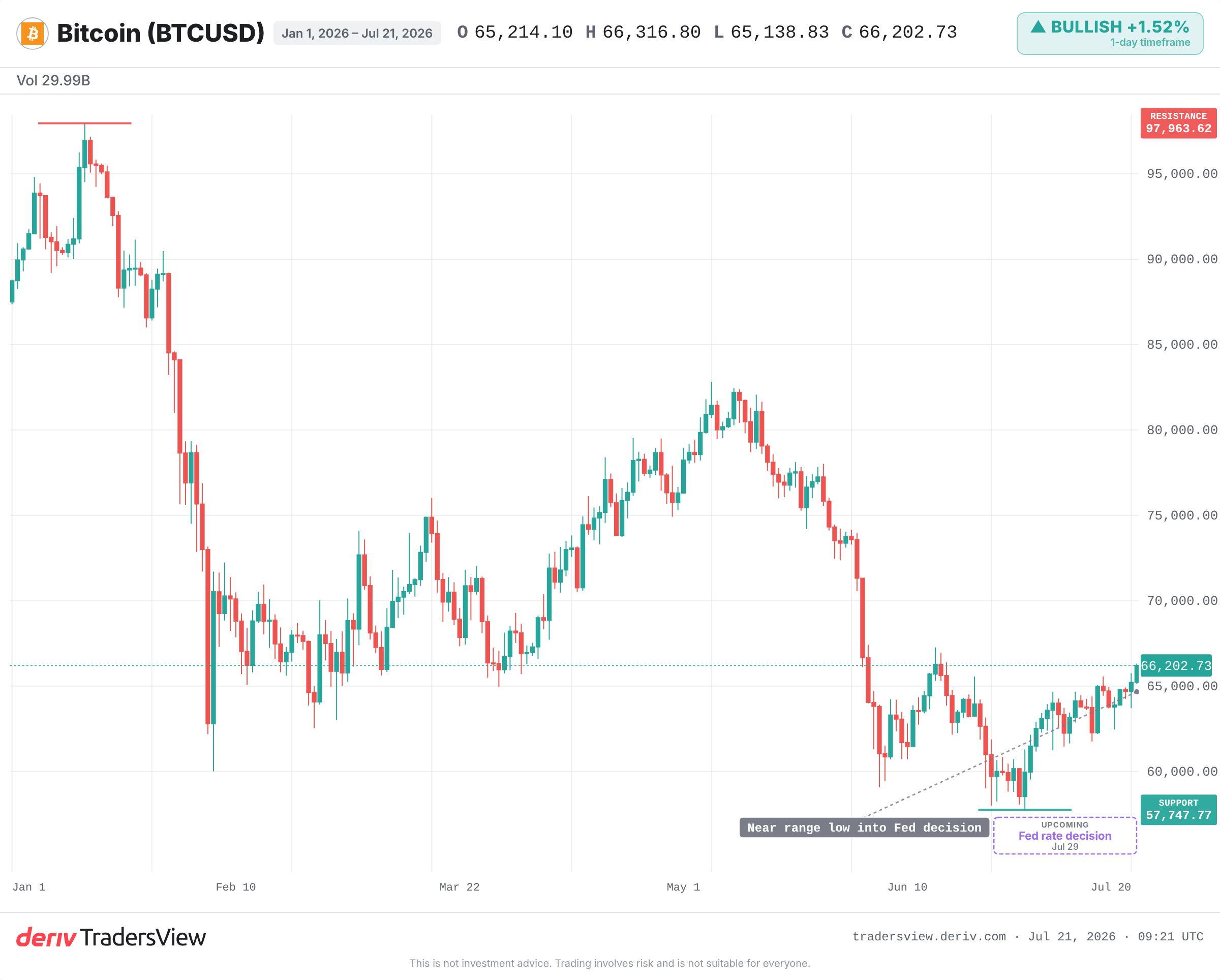
Volume is the size of the crowd, not the way it is facing. When the unknown resolves, one side is wrong and rushes for the exit. That is what turns a coiled spring into a fast move.
The surprise moves the price, not the decision
What matters is the gap between what the Fed does and what the market already expected. A decision that lands as priced can pass quietly. A surprise, in either direction, forces a repricing.
During the rate-hiking cycle in 2022, Bitcoin repeatedly saw volatility cluster on decision days. Hawkish surprises coincided with sharp single-day drops. Dovish signals sparked relief rallies. The reaction tracked the surprise, not the headline figure.
Forward guidance often matters more than the rate itself. The tone of what comes next, and any shift in the projections, can move the tape harder than the decision.
Does heavy positioning mean a bullish setup?
The obvious read is bullish: rising volume plus returning ETF inflows, after an eight-week outflow streak finally reversed. That is a real support, and it is worth watching whether the inflows hold or slip back.
The counter is stronger. Crowded positioning is what fuels reversals. In March 2024, Bitcoin ran to then-record highs into a Fed meeting as ETF inflows surged and leveraged longs stacked up. A drawdown of roughly 15 to 20 per cent followed as those longs unwound.
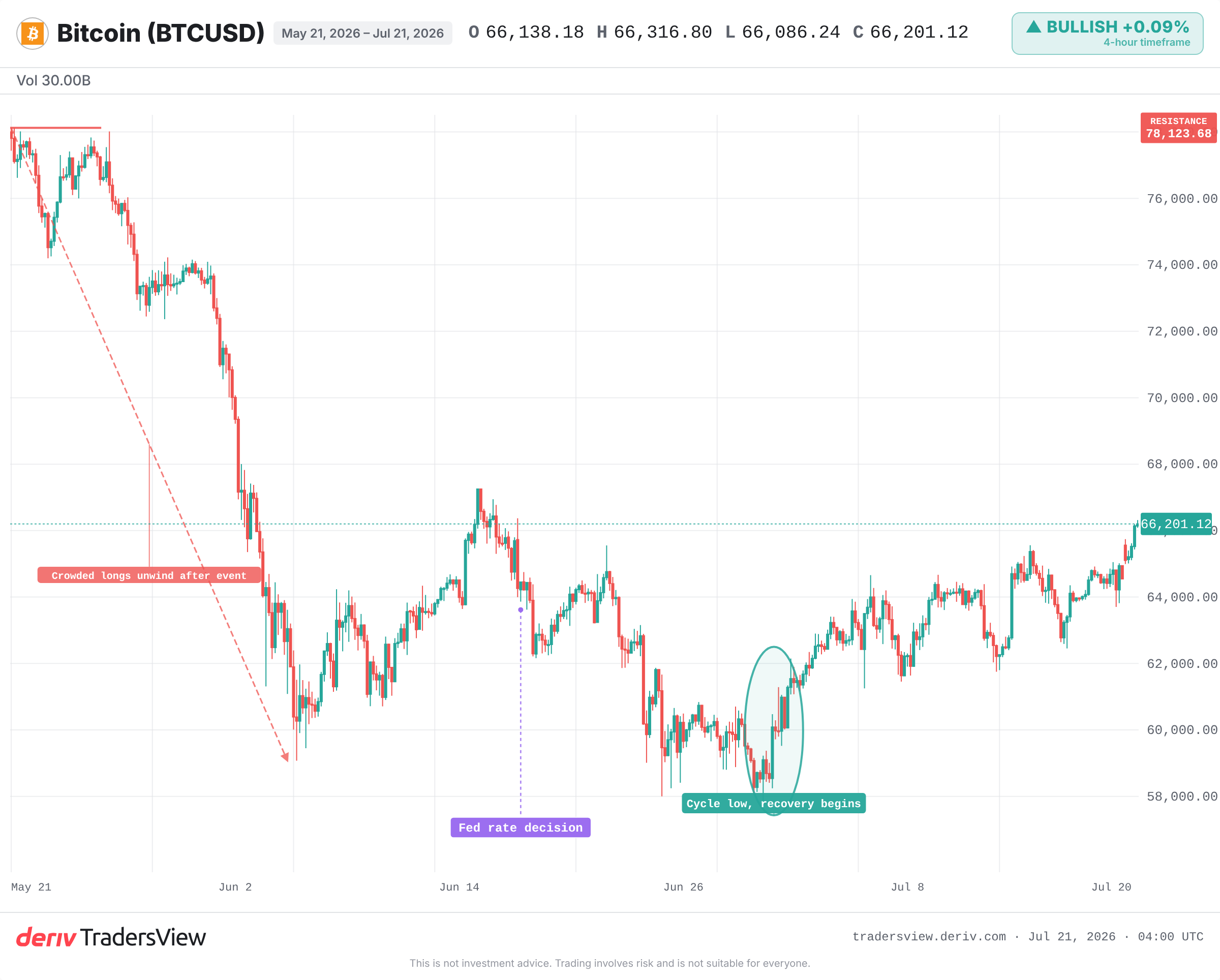
Heavy pre-event positioning cuts both ways. The more one-sided the crowd, the more fuel there is for a shakeout if the outcome disappoints.
When macro overrides Bitcoin's own story
Bitcoin's bullish drivers can lose to a rate shock in the short term. In August 2024, the yen carry unwind triggered a rapid crypto sell-off despite supportive ETF flows. The price fell hard intraday, then recovered over weeks.
A macro force can take the wheel for a session and override the crypto-specific narrative entirely. The evidence leans towards treating this stretch as high-volatility, not high-conviction.
What to watch around the decision
- Whether the decision surprises versus what the market expected, and the tone of forward guidance.
- Funding rates and open interest for signs of over-leveraged positioning that could force liquidations.
- Whether ETF inflows keep building or slip back into outflows.
- A hold or break of the recent range low versus a reclaim towards the year's high.
The setup is a spring, not an arrow. It is loaded, but it does not tell you which way it points. Trading around a scheduled catalyst carries real risk of a sharp move against any position, and this is education, not advice.
Frequently asked questions
The Federal Reserve sets US interest rates at scheduled meetings of its policy committee, held roughly eight times a year. The decision and its accompanying guidance are published on a fixed date, which markets watch closely as a known catalyst.
Higher rates make yield-bearing assets more attractive and tighten liquidity, which can pull capital away from riskier assets like Bitcoin. Rate expectations also shape the broader risk appetite that crypto tends to move with.
Open interest is the total value of outstanding derivatives contracts, a gauge of how much leverage is in the market. Funding rates are periodic payments between long and short traders on perpetual futures; extreme readings can flag one-sided, over-leveraged positioning.
No. Inflows add demand and can support price, but they can be overridden by macro shocks in the short term, as the August 2024 sell-off showed despite supportive flows. Inflows can also reverse quickly.