
One good week for Ethereum ETFs: real turn or a blip?
Ethereum ETFs just broke an eight-week outflow streak. Here is why fund flows show real demand, and why one strong week is not yet a turn.
By the Deriv desk · 21 July 2026 · 3 min read

Spot Ethereum ETFs broke an eight-week outflow streak in mid-July 2026, but a single strong week reverses a mood, not a trend. Fund flows are a cleaner read on institutional demand than price alone. One week after two months of exits is an inflection to watch, not confirmation the tide has turned.
Why fund flows tell you more than price
Price moves on everyone at once: traders, algorithms, panic and hope. ETF flows are narrower. They show what large, slow money is actually doing with its cash.
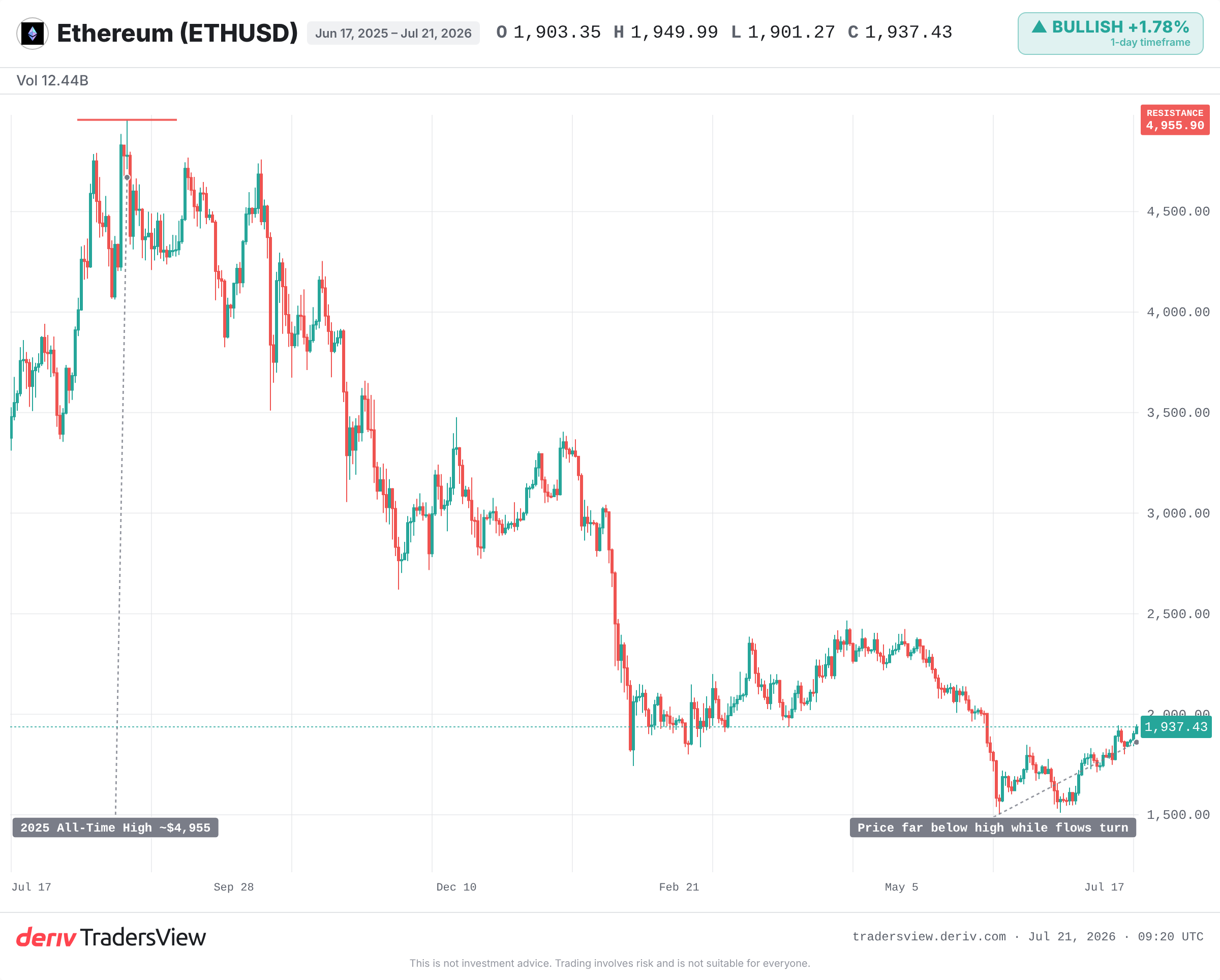
When capital flows into a spot ETF, someone has committed real dollars to hold the asset. When it flows out, they are backing away. That makes flows a useful gauge of conviction, the quiet decisions behind the noisy chart.
The week of 13 to 17 July 2026 drew roughly $105m into spot Ethereum ETFs, the best week since April. After eight straight weeks of outflows, the direction changed. The question is whether it holds.
Why a single print can fake you out
The Bitcoin ETF launch in January 2024 is the clearest lesson. Flows quickly became the market's main demand gauge. Early inflow weeks were followed by outflow stretches before any durable trend appeared.
Ethereum told the same story through late 2024 and early 2025. Inflow bursts arrived, then faded. Price only followed when inflows persisted for several consecutive weeks, not after one strong figure.
A single week can reflect one large buyer, a rebalancing, or a short-lived shift in mood. A trend needs repetition. That is the difference between a signal to watch and a signal to trust.
The institutional picture is contradictory
The money behind Ethereum is not speaking with one voice. That matters when reading whether conviction is genuinely turning.
Bitmine keeps accumulating, pushing towards a target of 5% of Ethereum's supply. Yet its own stock has fallen sharply this year. One whale who bought near the 2025 highs is sitting on a deep paper loss as Ethereum trades far below where they entered.
Ethereum now holds the larger share of the tokenised ETF market, a real fundamentals point. But outside analysts do not yet treat a tokenisation-driven recovery as their base case for 2026. Accumulation and doubt sit side by side.
What to watch before calling a turn
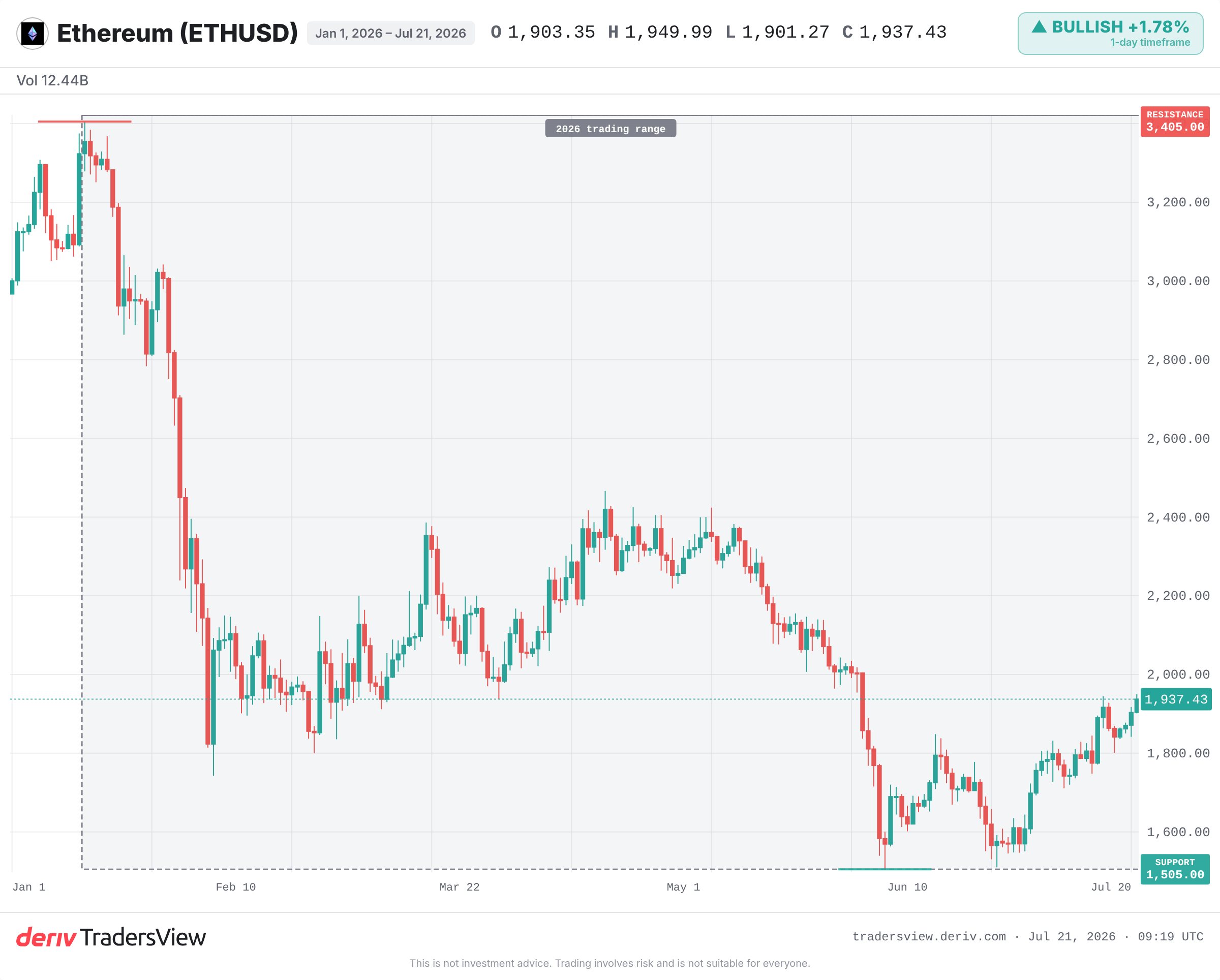
Ethereum trades well below its record high and inside a wide range for the year. The bullish read only becomes right if two things happen together.
- Inflows persist for several more weeks rather than reverting to outflows. One print is an event; a streak is a trend.
- Price breaks out of its 2026 range with conviction, holding above the lower end and pushing towards the upper end.
Watch Bitmine's accumulation against its falling share price as a sentiment tension. Watch broader risk-asset conditions, since crypto flows rarely move alone. The evidence leans towards cautious interest, not a confirmed reversal. If the inflows dry up next week, the streak was noise. If they compound, the read changes. Crypto stays volatile, and a single week proves little either way.
Frequently asked questions
They track the net dollars moving into or out of the funds over a period, usually reported weekly. Net inflows mean more capital entered the funds than left; net outflows mean the reverse.
Price reflects all traders at once, including short-term speculation. Flows reflect only the slower money committing to hold via the fund, so the two can diverge over short periods.
It measures how much of the assets held in tokenisation-focused funds sit in a given asset. A large share signals that fund providers favour that asset for this use, though it does not guarantee price gains.
Not directly. An unrealised loss only becomes a market factor if the holder sells. It is more useful as a sentiment signal about where large buyers entered.