
A one-day oil spike three times normal, signal or noise?
Oil jumped three times its normal daily range on Hormuz fears. How to read the size of a one-day move and why the biggest spikes often fade fastest.
By the Deriv desk · 14 July 2026 · 3 min read

The size of a single day's move is information. When oil swings several times its normal daily range, that outsized jump is the market putting a number on fear, and fear tends to overshoot.
Oil jumped hard as a standoff over the Strait of Hormuz escalated between the US and Iran. Over roughly two days it ran from about $74 to $83 before easing back. Set that against a normal daily move of under $3, and the point is clear. This was not a routine session. It was the crowd pricing a worst case in real time.
What the size of a move actually measures
Direction tells you which way the crowd leaned. Magnitude tells you how hard. A market that moves three times its usual daily range is not just trending. It is registering how much fear, or relief, traders are willing to pay for right now.
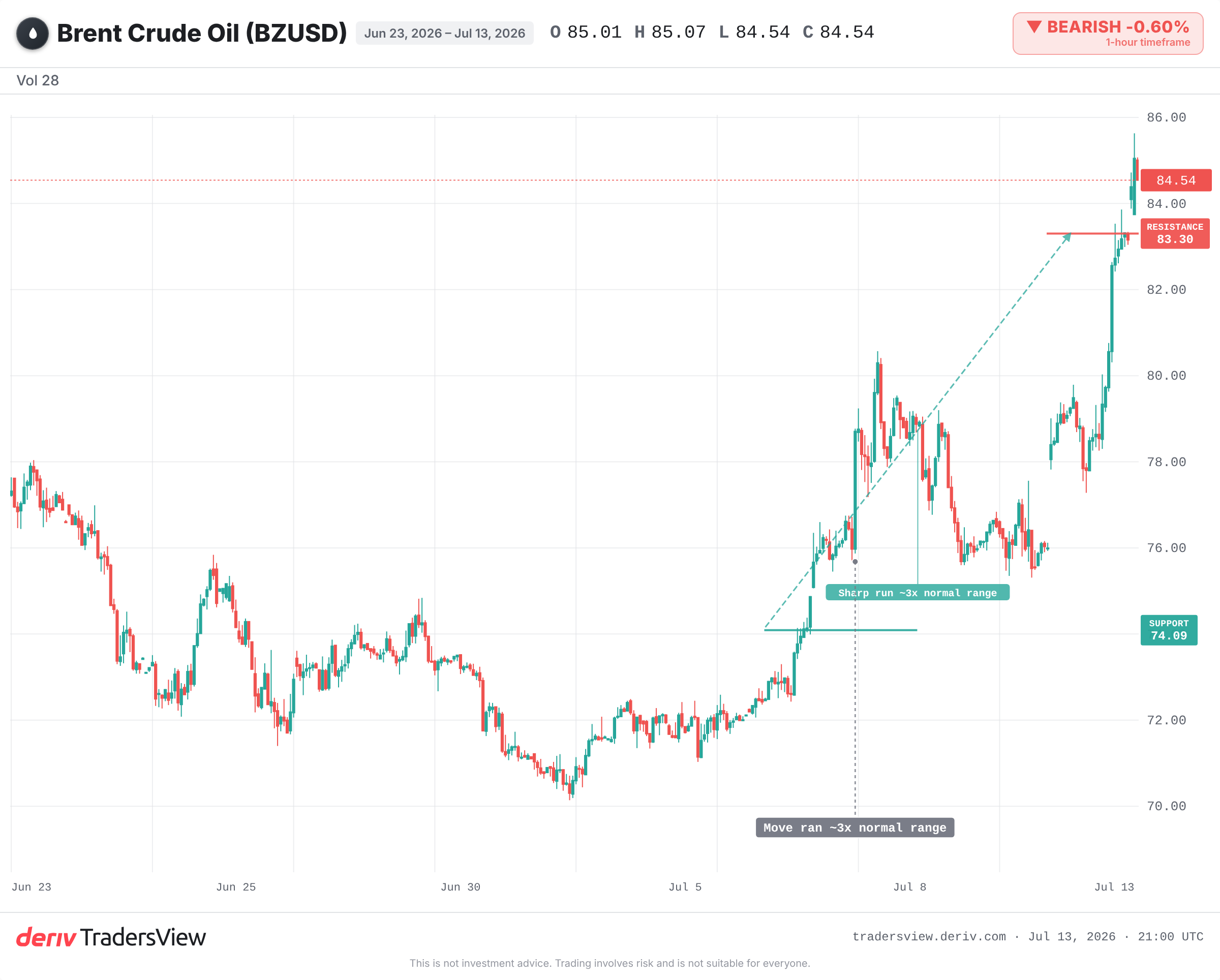
Think of the daily range as a fear gauge you can read without any special tool. Oil's typical daily move sits near $2.87. A two-day run of about $9 is that gauge redlining. The bigger the jump above normal, the more anxiety is baked into the price.
Why the biggest fear spikes tend to fade fastest
The obvious read is that a big jump means more of the same is coming. The record leans the other way. Outsized, fear-driven spikes price a worst case that usually does not fully arrive, so they are the ones most prone to snapping back.
In 2019, drone strikes on Saudi Arabia's Abqaiq facility knocked out roughly half the kingdom's output. Crude posted its largest single-day jump in decades. Within weeks, most of that spike had gone as output was restored faster than feared.
In 2022, Brent surged towards $130 after Russia invaded Ukraine. That was a genuine supply-security scare. Yet prices drifted back down over the following months as flows rerouted rather than vanished. And in April 2026, oil reportedly soared to a four-year high on strike fears, then fell more than a quarter intraday once de-escalation signals landed. A fear premium can be added and removed within a single session.
When a spike is justified, and when it bleeds out
Not every big move fades. The test is whether real supply is lost or only feared lost. A Hormuz closure that actually chokes off a large share of seaborne crude for a sustained period would justify the spike and extend it. A symbolic or short-lived disruption would see the premium drain away, as it has after past scares.
So the question is not how far oil jumped. It is what the jump is paying for: an actual, lasting supply gap, or a precautionary bid that unwinds the moment headlines soften.
What to watch as the fear gauge resets
- Whether Hormuz tanker traffic stays depressed or normalises. It reportedly hit a five-week low.
- The daily range itself. A move back towards the roughly $3 normal signals fear draining out.
- A break above the recent high near $83 (fear intensifying) versus a slide towards the pre-spike level near $74 (fear fading).
- Signs of genuine supply loss versus purely precautionary buying.
- Any diplomatic de-escalation headline, which historically collapses fear premiums fast.
The evidence leans towards fade over follow-through unless a real supply gap opens. That is a lean, not a certainty: a sustained closure would rewrite it, and the direction of any one session is never given. Read the size of the move as a fear reading, watch whether that fear is being confirmed by real disruption, and you have a sharper frame than chasing the spike.
Frequently asked questions
ATR measures how much a market typically moves over a set period, often 14 days. Traders use it as a baseline for normal volatility, so a day that moves several times the ATR stands out as unusually active.
A large share of the world's seaborne crude passes through the narrow Strait of Hormuz. Any threat to close or disrupt it raises fears of a supply squeeze, which can push prices up quickly even before actual barrels are lost.
Look for evidence of real, sustained supply loss rather than precautionary buying. If tanker flows and output stay disrupted for a prolonged period, a spike has grounds to hold; if disruption proves short-lived, the added premium tends to unwind.
No. The size of a move measures how much fear or relief is being priced, not where prices go next. Direction over the following sessions depends on whether the underlying fear is confirmed or fades.