
Microsoft won and lost the same AI bet in one quarter
Microsoft booked a $3.2bn AI gain and an AI write-down in the same quarter. Why 'is it an AI stock?' is the wrong question, and what to ask instead.
By the Deriv desk · 30 July 2026 · 4 min read

Microsoft booked a $3.2bn gain on one AI investment and a write-down on another in the same three months. That split is the whole lesson: asking whether a company has AI exposure tells you almost nothing.
In its fiscal fourth quarter, Microsoft marked its Anthropic stake up by $3.2bn and wrote its OpenAI stake down by around $600m. Same theme, same roof, same quarter, opposite results. The useful question was never "is this an AI stock?" It is "which of its AI bets are working, and which are bleeding?"

Why one AI bet can win while another loses
A theme is not a single trade. "AI" inside one company can fan out into several separate positions, and they do not move together.
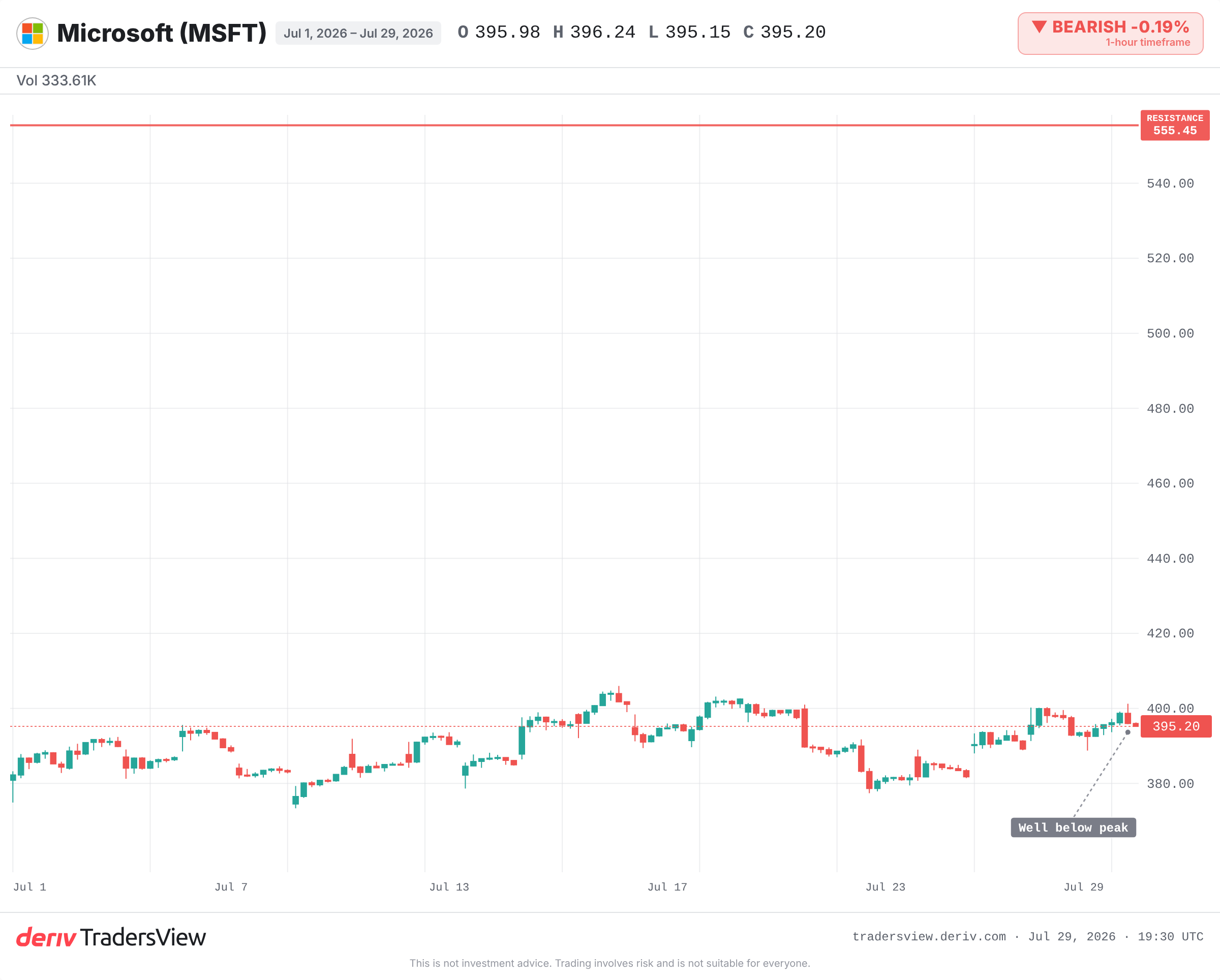
Microsoft holds stakes in both Anthropic and OpenAI, two of the leading model makers. This quarter, the accounting marked one up and the other down. The Anthropic gain almost matched the full year's OpenAI gain on its own. Owning "AI" through Microsoft meant owning a winner and a loser at once, and the headline exposure hid both.
Record revenue and record spending, stock below its peak
The rest of the report was strong. Microsoft closed a record fiscal year, with cloud revenue crossing $100bn annually for the first time and its cloud segment growing fast.
Yet the stock still trades well below its prior all-time high. The reason sits next to the good news: capital spending jumped roughly 70% year on year, with far more guided for the year ahead. The market is weighing whether that spend converts into durable revenue or into an expensive arms race. Strong headline growth does not settle that question.
The pattern is old, only the theme is new
Split bets inside one company are not new.
- In the 2000s, Google and Yahoo were both "search". One execution path compounded, the other faded. Owning the theme broadly still lost you money if you held the wrong horse.
- In the 2010s, Amazon carried low-margin retail and high-margin cloud under one roof. The market kept pricing the wrong half. The smaller, less obvious segment drove the stock.
- In 2022 and 2023, Meta's core ads business and its loss-making metaverse unit pulled the stock in opposite directions inside the same reports.
Each time, the reward went to whoever looked inside rather than at the label.
Is the split a flaw or a strength?
There is a real bull case. Being spread across the AI leaders is exactly the hedge a platform owner wants. Being wrong on one stake while right on another is diversification working, not failing. The mark-up and write-down are also non-cash accounting swings, so a single quarter's marks say little about the underlying businesses.
That read holds if cloud keeps compounding and the heavy spending turns into lasting revenue. It breaks if the spend outruns what the AI products earn, and if this quarter's marks turn out to signal real deterioration rather than noise. Watching one quarter's direction proves nothing. Watching several does.
What to watch from here
The evidence leans towards reading Microsoft as a basket of AI bets, not one. So track the parts, not the label:
- Whether cloud growth and AI revenue keep pace with the surge in spending, or margins compress as spend runs ahead.
- Which way the Anthropic and OpenAI marks move next quarter. A reversal would show these swings are noise.
- The gap between the price and its prior peak, as a gauge of how much AI optimism has already deflated.
None of this is a trade call. It is a way to read the company. A theme can be right while a specific bet inside it is wrong, and the label on the front door will not tell you which is which.
Frequently asked questions
These are non-cash accounting marks that reflect changes in the estimated value of each stake in the quarter. One was revalued higher and the other lower. A single quarter's marks say little on their own about how the underlying businesses are performing.
Exposure to a theme tells you little by itself. A firm can hold several bets on the same trend, and they can move in opposite directions at once. What matters is which specific bets are paying and which are draining money.
Capex is capital expenditure, the money a company spends on long-term assets like data centres and chips. A steep rise matters because investors want to see it convert into durable revenue rather than a one-off spending race that squeezes margins.
Read the segment breakdown in the earnings report rather than the headline number. Look at which divisions are growing, which are losing money, and how the market's attention shifts between them over several quarters.