
A hyped IPO doubled then gave it all back: who wears the loss?
A newly listed stock has no price history beneath it, so when hype fades late buyers wear the loss. How the IPO round-trip works, using SpaceX stock.
By the Deriv desk · 13 July 2026 · 3 min read

A newly listed stock has no price history beneath it, so when hype fades there is nothing to catch the fall, and whoever bought late wears the loss.
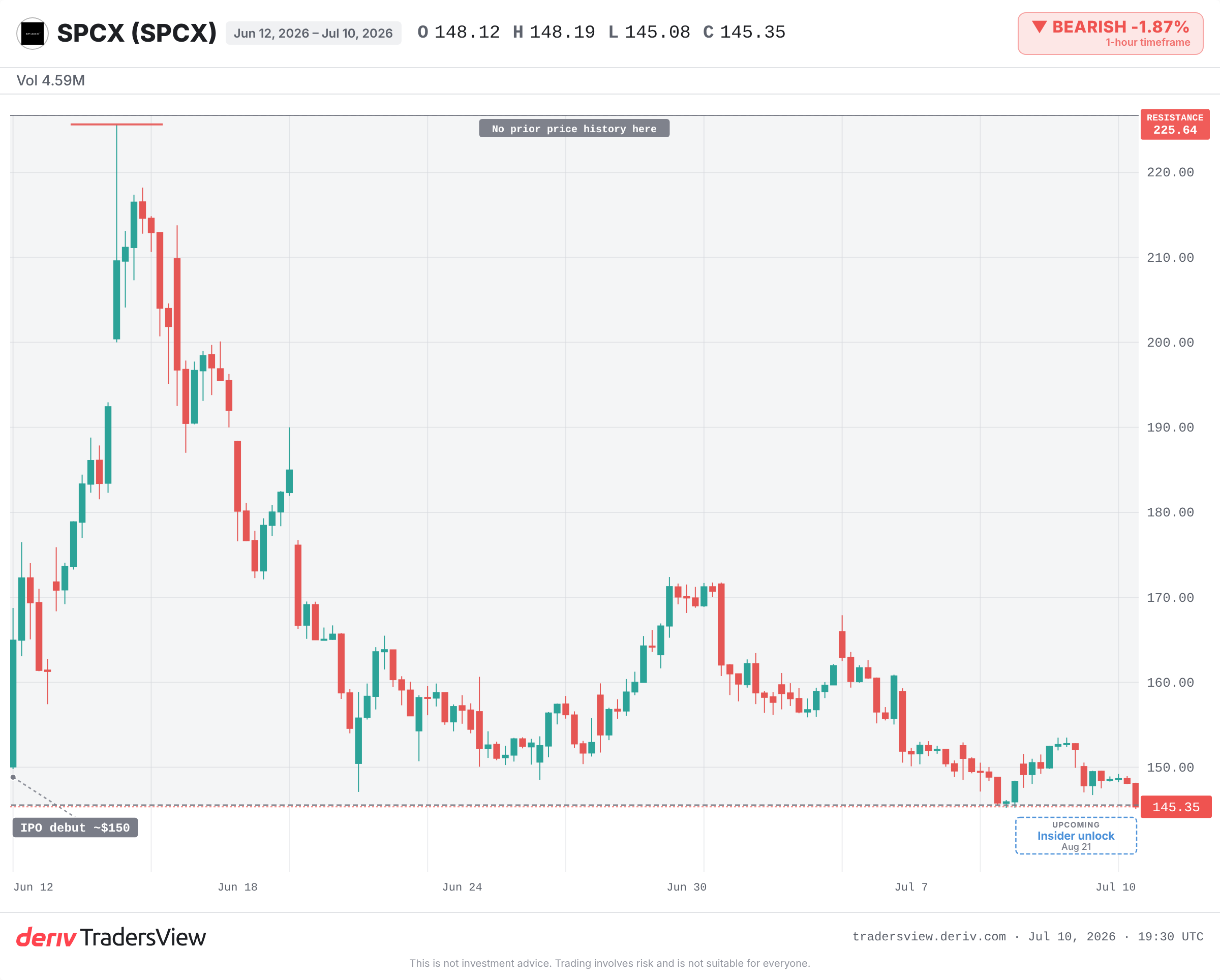
SpaceX's public stock (SPCX.OQ) is the live example. It listed on 12 June 2026 near $150, spiked above $225 within about a month, then round-tripped the whole move. As of 13 July 2026, it trades near its all-time low, back below its debut price.
Why a young stock has no floor
A beaten-down blue chip has years of chart history. Old support levels, prior buyers, a range people remember. A stock that has traded for weeks has none of that.
SpaceX's five-year range and its year-to-date range are the same. That is not a coincidence. The entire life of the stock, high to low, fits inside one short listing window.
At an all-time low, there is no prior price beneath you by definition. The next buyer is not stepping onto a known level. They are guessing.
The round-trip is an old pattern
This has happened before, repeatedly, to famous names. Uber and Lyft debuted to huge demand in 2019, then traded below their IPO prices within weeks. Facebook fell hard below its $38 debut in 2012 and took over a year to reclaim it.
The 2020 and 2021 wave of space and EV listings ran further and fell harder. Many spiked well above debut, then gave the whole gain back once momentum faded.
A hot brand does not create a floor. Enthusiasm sets the launch price; fundamentals set where it settles, and the two can be far apart.
The schedule that decides what happens next
Two things sit ahead of SpaceX that hype cannot paper over. First, insider lockups. A first unlock of roughly 7% of shares is due around 21 August 2026, a second around 10 September, with up to 44% sellable over time.
Second, the first public earnings report. That is the first hard check against hype-era expectations.
Either can add supply or disappointment when the stock already has nothing beneath it. Lockup expiry has pushed hyped IPOs lower before, and this one lands into a weak chart.
Is the round-trip the bottom?
The tempting read is that the hype is gone, so buy the fundamentals. It might be right. But the round-trip is not automatically the bottom.
The stock swings roughly 8% on a normal day, so a single session can move the whole story. A clean break of the all-time low leaves no prior history to lean on.
The bull case only holds if earnings clear a high bar and insiders visibly hold rather than sell into the unlock windows. Until then, the honest read is that a new listing at its low is a different, thinner kind of risk than a cheap established name.
Watch the low, the unlock dates, and the first report. Those tell you whether price is finding fundamentals or still falling towards them.

Frequently asked questions
It is a set window after a listing during which insiders and early investors are barred from selling their shares. When it expires, a wave of new shares can hit the market, often adding selling pressure. SpaceX's first unlock is due around 21 August 2026.
Launch demand sets an initial price built on enthusiasm rather than trading history. Once that fades, the price drifts towards what fundamentals support, which can be lower. Uber, Lyft and Facebook all traded below their debut prices within weeks of listing.
An established stock has years of chart history: old support levels and prior buyers who remember a range. A stock at its all-time low, weeks after listing, has no prior price beneath it, so there are no known levels for buyers to lean on.
Average True Range measures a stock's typical daily move. A large ATR relative to price means big normal swings, so a single session can shift a position sharply. SpaceX's stock moves roughly 8% on a normal day.