
One in five barrels flows through Hormuz, so why has oil settled back to $75?
Oil spiked over 3% to $78.68 when Iran declared the Strait of Hormuz closed, but WLDOIL has since settled back to about $75.06 as US-Iran de-escalation reports point to reopening. The market priced the odds of a lasting disruption, not the worst case, and that gap is the lesson for beginners.
By the Deriv desk · 14 July 2026 · 3 min read

A closure of the Strait of Hormuz threatens roughly one in five of the world's oil barrels, yet crude spiked only about 3% and has since fallen back. The market is pricing the odds a disruption sticks, not its worst case.
Iran declared the Strait of Hormuz "closed" and attacked ships trying to pass. On paper, that is a rare, high-magnitude event. Around 20% of global oil supply moves through that single channel.
The tape told a calmer story. Oil surged past $78 on the headline, then settled well below the spike. That gap between the shock and the price is the lesson.
Why a scary chokepoint headline does not mean a proportional move
A chokepoint is a single point every barrel must cross. Block it, and the theoretical impact is enormous. But price does not react to the theoretical maximum.
Markets price two things: how bad a disruption could be, and how likely it is to actually happen and last. A declaration is not a confirmed, sustained halt of traffic. Traders discount the headline by the odds it holds.
So the reaction reflects a probability, not a certainty. A 3% move says the market takes the threat seriously but doubts it will fully close and stay closed.
Two past shocks that show the difference
The 2019 tanker attacks near the Gulf of Oman spiked oil on the day. The Strait stayed open, flows continued, and the spike faded within days. The feared closure never came.
Russia's invasion of Ukraine in 2022 was different. That was a genuine, prolonged supply shock. Oil pushed to a record near $130, and the move held for months because the disruption was real.
The size and durability of a price move track the durability of the disruption, not the drama of the headline. One faded in days. One lasted for months.
The bull case: is the market too relaxed?
There is an honest other side. If Hormuz truly closed and stayed shut, around a fifth of world supply is at stake. Prices near the 2022 record, or higher, would be justified.
On that view, a modest reaction underprices the tail risk. This is a real possibility, not a straw man. It becomes the right read if tankers actually stop, reroute, and insurers pull back from Gulf transit.
The evidence so far leans the other way. Repeated flare-ups this year produced spikes above the high-$70s, and the tape repeatedly settled back. The market keeps treating each closure claim as probabilistic.
What to watch before reacting to a Hormuz headline
The signal is whether the disruption is real and lasting, not whether it is loud.
- A confirmed, sustained halt of tanker traffic, not just a declaration.
- Insurance and shipping-rate spikes for Gulf transit, a real-disruption sign.
- US and Iran escalation or de-escalation headlines.
- Oil breaking and holding above the recent spike zone, versus drifting back towards the year's mid-range.
- OPEC+ spare capacity or pipeline routes that offset Hormuz risk.
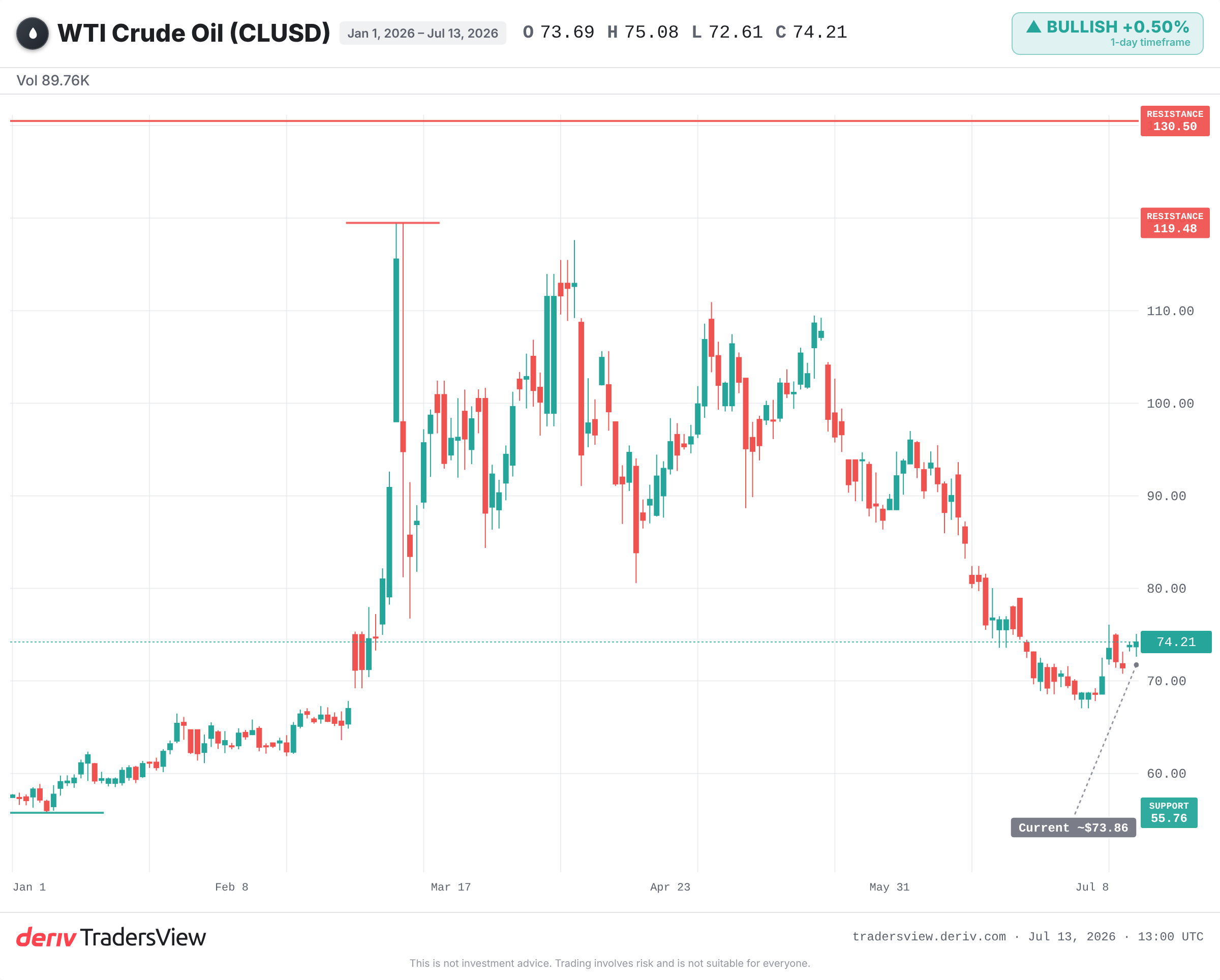
A critical chokepoint can move a whole market. But a headline about closing it is only the first input. What sets the lasting move is whether the flow actually stops.
Volatility around geopolitical headlines is sharp and can reverse fast. This is education and commentary, not a trade signal.
Frequently asked questions
Around one in five barrels of global oil supply moves through the Strait of Hormuz, which is why any threat to it draws attention far beyond a small price move.
A confirmed, sustained halt of tanker traffic, rather than a declaration. Signs include tankers rerouting or stopping, and insurers and shippers pulling back from Gulf transit.
The initial spike prices the theoretical impact, then the price fades as traders judge the closure unlikely to fully happen or last. The market discounts the headline by the odds it holds.
Spare capacity and alternative pipeline routes can partly offset Hormuz risk, which is one reason the market may treat a closure threat as less than a full supply loss. Watch for OPEC+ announcements on both.