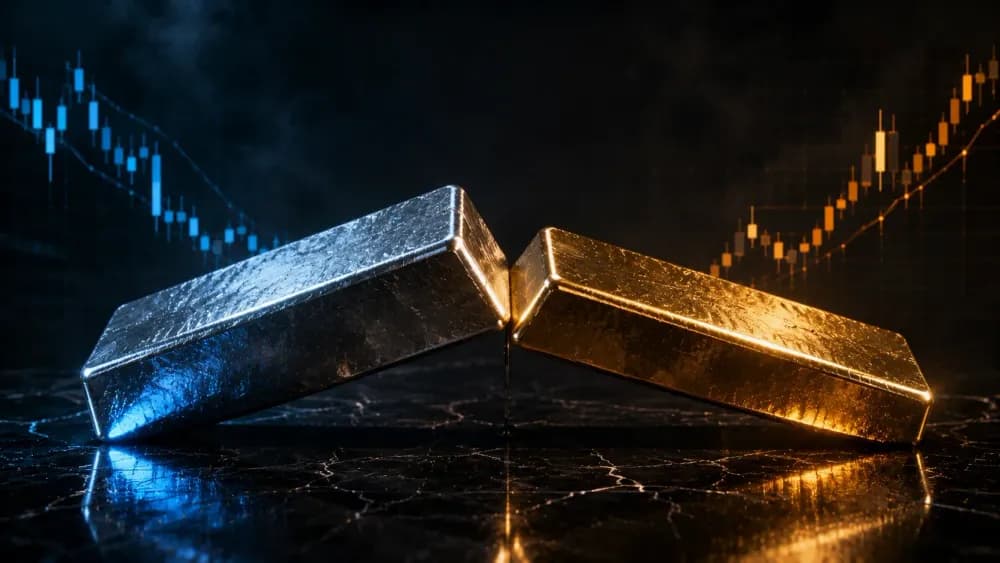
The week silver and gold stopped moving together
The week's most interesting move in precious metals is not how much silver has rallied. It is that gold has not joined it.
Spot silver has pushed into the high‑$80s an ounce, its highest level in around two months, while gold has eased back to trade just below $4,700 after recent gains. The two metals normally move together. This week they have pulled apart sharply enough to pull the gold-silver ratio down toward the mid‑50s — its tightest level in years as silver outperforms gold. Traders are watching a single complex price two opposing stories at once.
Why silver is rallying while gold is falling
The simplest way to read it: silver is being repriced as an industrial metal at the same moment gold is being repriced as a monetary one.
Industrial uses — solar panels, electric vehicles, semiconductors, AI data-centre buildout — account for the larger share of annual silver consumption, and a meaningful portion of that supply chain runs through China. The week opened with growing optimism around the Trump-Xi summit in Beijing and reports that Washington had cleared several Chinese firms, including Alibaba, Tencent, ByteDance and JD.com, to buy Nvidia's H200 AI chips. Together, those signals point toward a less constrained industrial demand backdrop. Silver has reacted accordingly, with single‑session moves of around 6% on the way up.
Gold has had no such tailwind. The metal is sensitive to real yields, and real yields have risen sharply.
How the April inflation data reshaped the rate path
April US consumer prices rose 3.8% year-on-year, the hottest reading since May 2023 and slightly above the 3.7% consensus. April producer prices accelerated to their largest monthly increase since early 2022, with both import and export prices climbing as higher energy costs linked to ongoing Middle East tensions fed through. According to CME Group's FedWatch tool, markets have largely priced out a Federal Reserve rate cut for 2026, and are assigning a meaningful probability to a December hike.
For gold, that combination is corrosive. A non-yielding asset competes badly when real yields rise, and a stronger dollar mechanically pressures a metal priced in dollars. India's decision to raise gold and silver import duties from 6% to 15% has added a separate physical‑demand headwind from one of the world's largest bullion consumers.
What the gold-silver ratio is signalling
Compression in the gold-silver ratio tends to occur when silver is leading the trade. When the move is driven almost entirely by silver — as it has been this week, with gold drifting lower — it is usually a sign that the market is pricing an industrial demand catalyst rather than a safe-haven one. The mid-50s zone is below the modern post-2000 average of roughly 60–65, leaving silver historically less cheap relative to gold than it was just a week ago.
Strategists note that ratio moves of this speed are rarely sustained without confirmation. If the trade thaw fades or April's inflation pressure persists into the May CPI print, the industrial repricing in silver could partially unwind. If the trade backdrop firms further and inflation cools, the dynamic could extend.
Trading context for the next two weeks
Volatility has picked up across the precious metals complex. Silver's intraday swings have widened, with traders citing thin liquidity above $85 and concentrated speculative positioning. Some analysts caution that price action is headline-dependent and could reverse quickly on any breakdown in trade negotiations or hawkish surprise from the Fed.
Technically, silver is testing resistance in the high‑$80s area, with January's peak above $120 still some distance overhead. Gold is consolidating just below the $4,700 level that has acted as near‑term support, with the late‑January record in the mid‑$5,500s unchallenged since the February correction.
What traders are watching next
Three catalysts dominate the calendar. The outcome of the Trump-Xi summit and any concrete trade announcements will continue to shape silver's industrial demand narrative. The May US CPI release, due in mid-June, will test whether April's inflation surprise was a single hot print or the start of a trend. And the 16–17 June FOMC meeting, with its updated dot plot, will tell traders whether the Fed itself has shifted its view of the rate path that has weighed on gold this week. Until then, the two metals look set to keep telling different stories.