
Flip vs Crash and Boom Indices explained
Flip Indices are Deriv synthetic indices where each sudden spike can be a crash or a boom, decided at random. Standard Crash and Boom Indices spike in a
By the Deriv desk · 20 August 2026 · 5 min read

Flip Indices are Deriv synthetic indices where each sudden spike can be a crash or a boom, decided at random. Standard Crash and Boom Indices spike in a fixed direction; Flip Indices leave that direction unknown. Everything else, from the tick-based structure to the numbering, works the same way.
If you already trade standard Crash or Boom Indices, Flip Indices will feel very familiar. Both share the same tick-based structure, appear on the same Deriv platforms, and use identical trading mechanics. The main difference lies in how market direction behaves.
How Crash and Boom Indices move
A Crash Index drops suddenly, then climbs slowly until the next drop. A Boom Index jumps up suddenly, then falls slowly until the next jump. For both indices, the direction of sudden price moves is fixed: Crash Indices always move down, while Boom Indices always move up. The number in the index name shows how frequently these sudden moves happen.
For example, a Crash 500 Index experiences a drop about once every 500 ticks, while a Crash 1000 Index drops about once every 1,000 ticks. A tick represents a single price update. A lower number means sudden moves happen more often, while a higher number means longer intervals between moves. The number indicates event frequency, not direction.
What changes with Flip
Unlike standard Crash or Boom Indices, a Crash Boom Flip Index does not have a fixed direction.
Each sudden move can randomly be a crash or a boom, generated independently every time. Past price moves do not influence future ones, meaning there’s no predictable directional pattern.
The numbering system works the same way: a Flip 500 Index has the same event frequency as a Crash 500 or Boom 500 Index. However, while the number tells you how often a move happens, it no longer indicates the direction. Standard indices define both frequency and direction, whereas Flip Indices define only frequency.
Because price direction is random, strategies relying on fixed directions from standard Crash or Boom Indices do not apply to Flip Indices. Traders must adapt their risk management for unpredictable price movements on every trade.
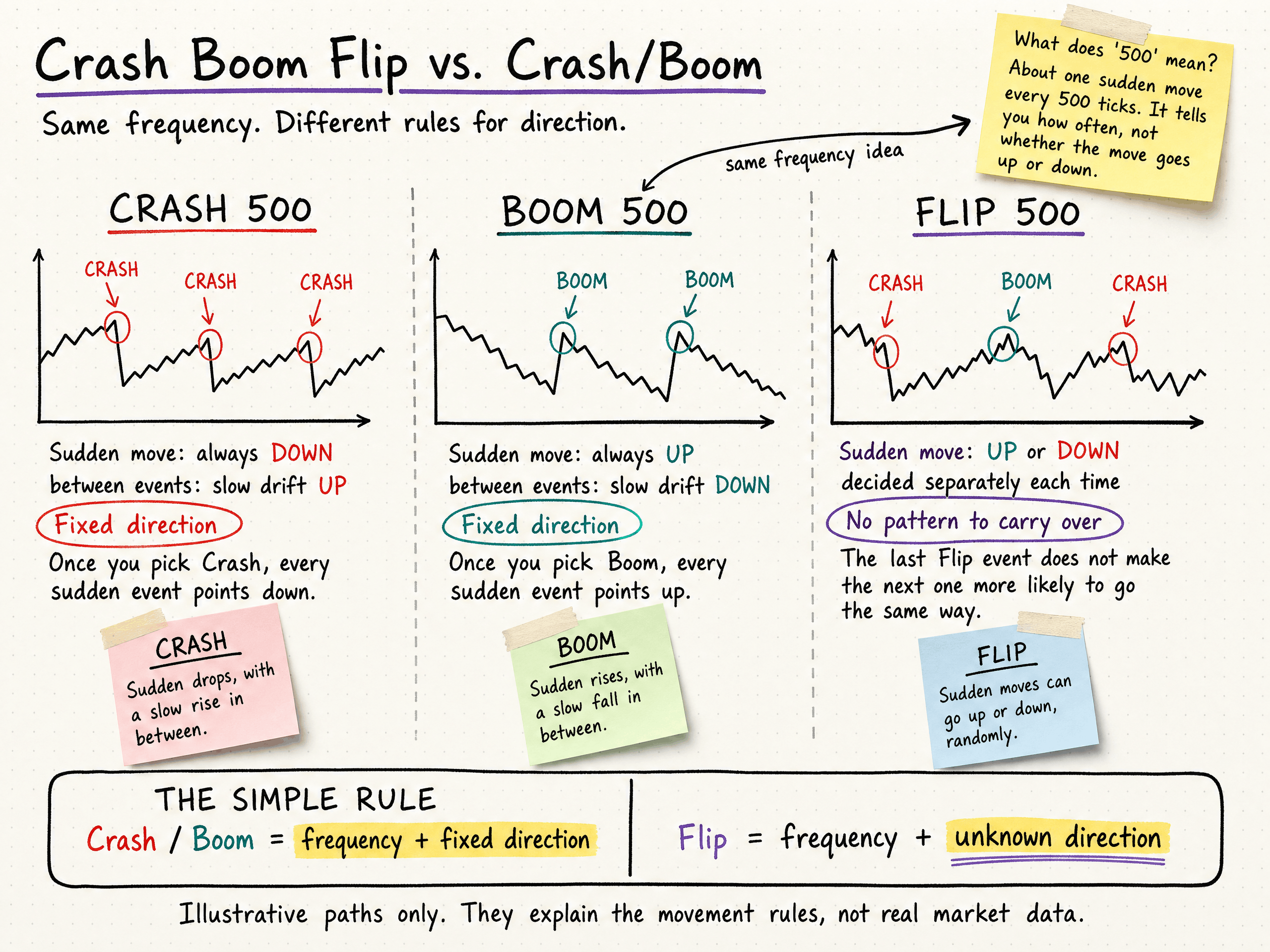
A quick side-by-side
| Index | Sudden move | Between events |
| Crash | Always drops down | Drifts up |
| Boom | Always jumps up | Drifts down |
| Crash Boom Flip | Randomly drops or jumps | Direction is unpredictable |
Choosing between them
● Choose Crash or Boom Indices if you prefer trading with a fixed, known direction and a consistent movement pattern around sudden spikes or drops.
● Choose Flip Indices if you prefer trading two-way market movements where price spikes can occur in either direction at any time.
● Trade both to diversify strategies. These indices operate independently, so market activity in standard Crash/Boom Indices has no effect on Flip Indices.
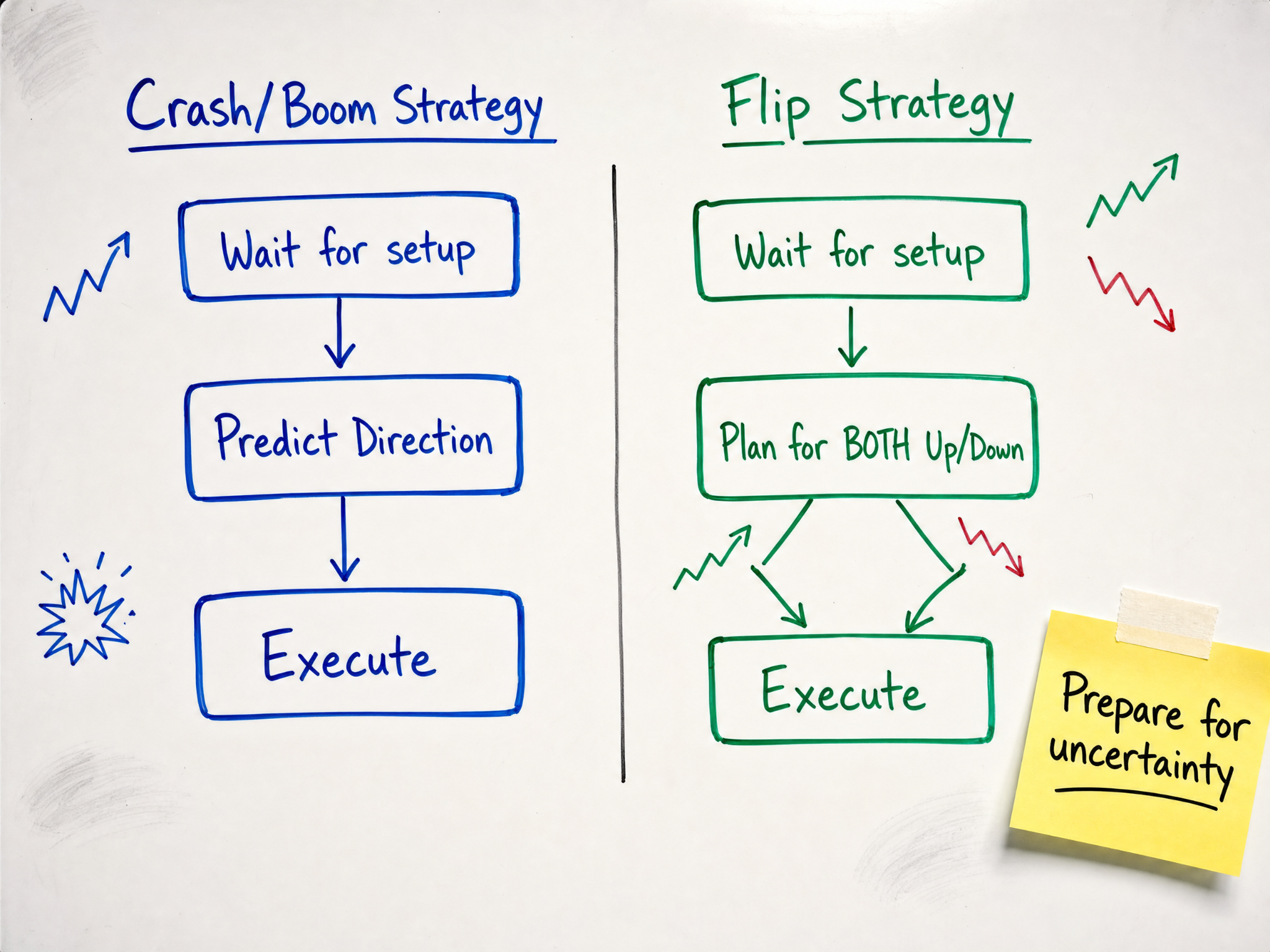
Compare them yourself
The best way to understand how these indices differ is to observe them live on price charts. You can open a free Deriv demo account to chart Crash, Boom, and Flip Indices side by side to practise trading strategies.
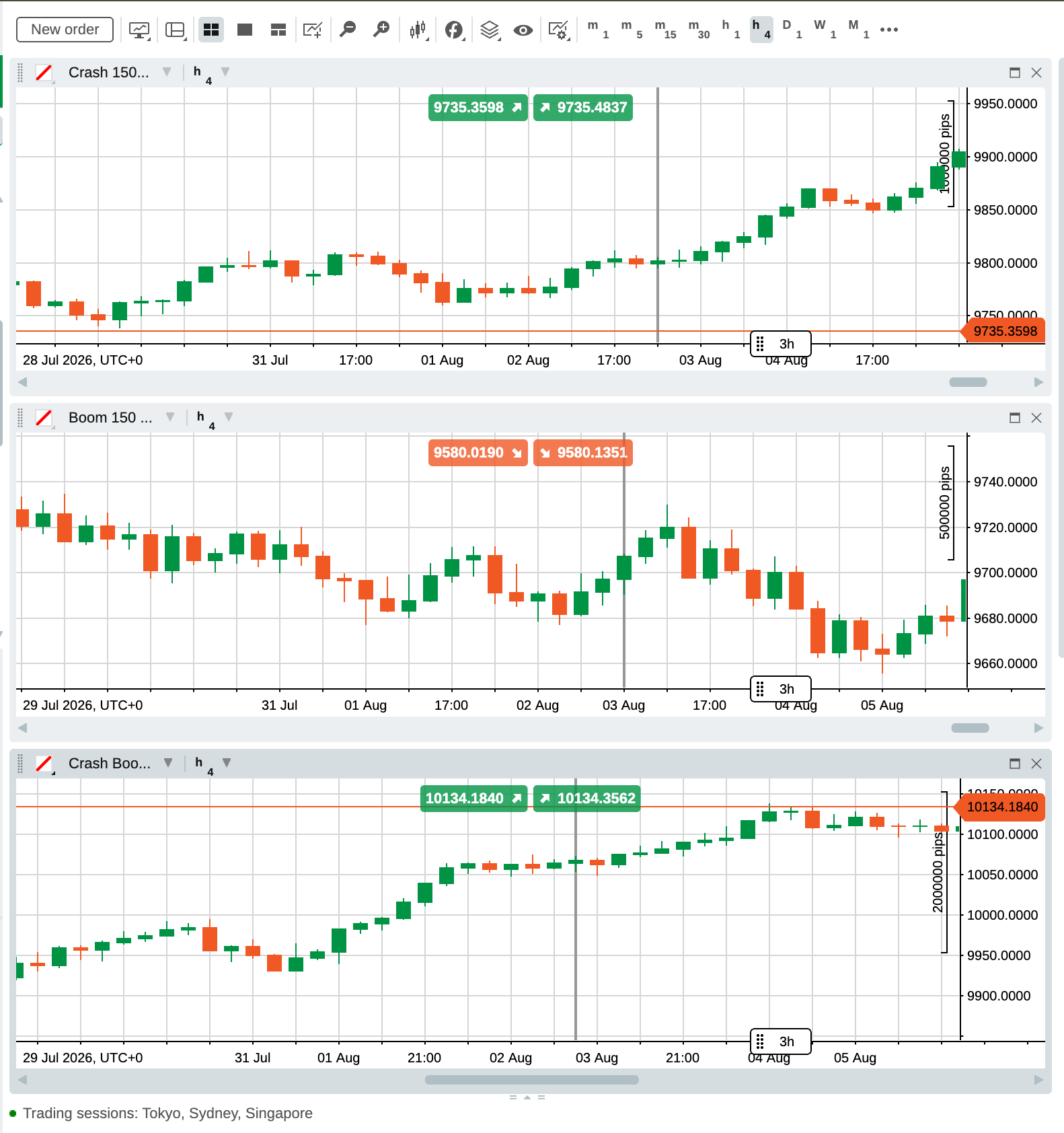
Monitor each chart for a few minutes. You will notice that Crash and Boom Indices follow a consistent cycle (e.g., drop, slow rise, drop). In contrast, the Flip Index moves unpredictably, which is its defining feature.
Can technical indicators predict spike direction on Flip Indices?
No. Each spike on a Flip Index is generated independently, and past moves do not influence future ones. That means no indicator can tell you whether the next spike will be a crash or a boom. Indicators can still help with timing, volatility and risk sizing, but not with direction. With standard Crash or Boom Indices the direction is fixed in advance, so the read is different: you already know which way the spike goes.
Which timeframe suits catching spikes?
The one-minute timeframe suits catching spikes best, because it shows them as they happen and lets you react quickly. The trade-off is more noise and faster decisions. On Crash and Boom Indices you can plan around the fixed direction of the spike. On Flip Indices you cannot, so plan for a move in either direction and set your risk before the spike, not after. Test a few lower timeframes on a demo account and keep the one that matches how quickly you can act.
Where can you trade these indices?
Crash, Boom and Flip Indices are Deriv synthetic indices, so they are available on Deriv platforms. You can access them on Deriv cTrader, as shown in the charts above, and on other Deriv trading platforms. Open the platform, search for the index by name, for example Crash 500 or Flip 150, and add it to your watchlist to chart it live.
The takeaway and your next step
The rule is simple. Crash and Boom Indices give you frequency and a fixed direction. Flip Indices give you frequency but leave direction unknown, decided fresh on every spike. Everything else, from the tick-based structure to the numbering, works the same way.
The clearest next step is to watch all three side by side. Open a free Deriv demo account, chart Crash, Boom and Flip Indices together, and see the difference in direction for yourself before committing real funds.
Trading involves significant risk. You may lose some or all of your invested capital.