
Does a Bank of Japan hike actually pull USD/JPY down?
USD/JPY tracks the gap between the Fed and the Bank of Japan. Why a September BoJ hike may firm the yen, or already be priced in.
By the Deriv desk · 14 August 2026 · 4 min read

USD/JPY is a bet on one thing: the gap between what the Fed pays and what the Bank of Japan pays. When that gap narrows, the yen tends to firm and USD/JPY falls. That is why the whole dollar-yen trade now hangs on a single date, the BoJ's meeting on 17-18 September.
Why the rate gap, not either bank alone, drives dollar-yen
A currency pair is a relative price. It moves on the difference between two countries' interest-rate paths, not on one central bank in isolation.
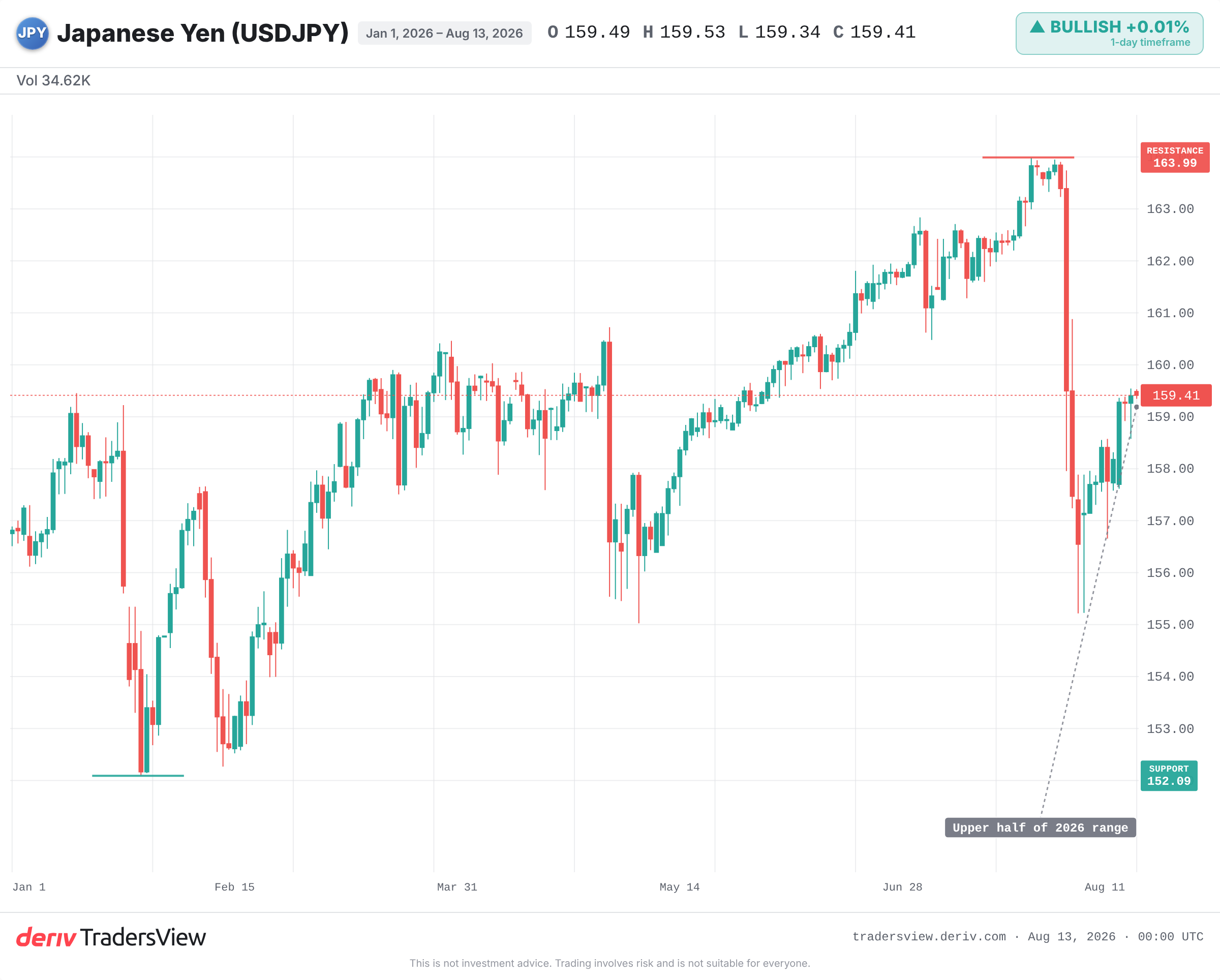
Right now the Fed pays far more than the BoJ. Capital parks in higher-yielding dollar assets. That wide gap is the engine behind USD/JPY holding in the upper half of its 2026 range, closer to the year's high than its low.
Close the gap and you reverse the incentive. A BoJ hike narrows the differential, makes holding yen assets relatively more attractive, and pulls the pair down. So a September move matters less for the hike itself than for what it does to the gap.
Why an expected hike can move the yen the wrong way
Markets price the future, not the past. If a hike is fully anticipated, the currency has already moved before the decision lands.
The market-implied odds of a September hike have jumped sharply, from around a quarter to roughly three-quarters in two weeks, according to Tokyo Tanshi data. Polymarket has leaned even higher. When odds are that high, much of the yen strength may already be in the price.
An expected hike can even trigger a bounce in USD/JPY, a classic buy-the-rumour, sell-the-fact move. What decides the reaction is the surprise, not the hike.
What March 2024 and July 2024 teach about priced-in moves
A priced-in hike barely moves the yen; a hike that shifts the whole expected rate path moves it violently. Two recent episodes map this cleanly.
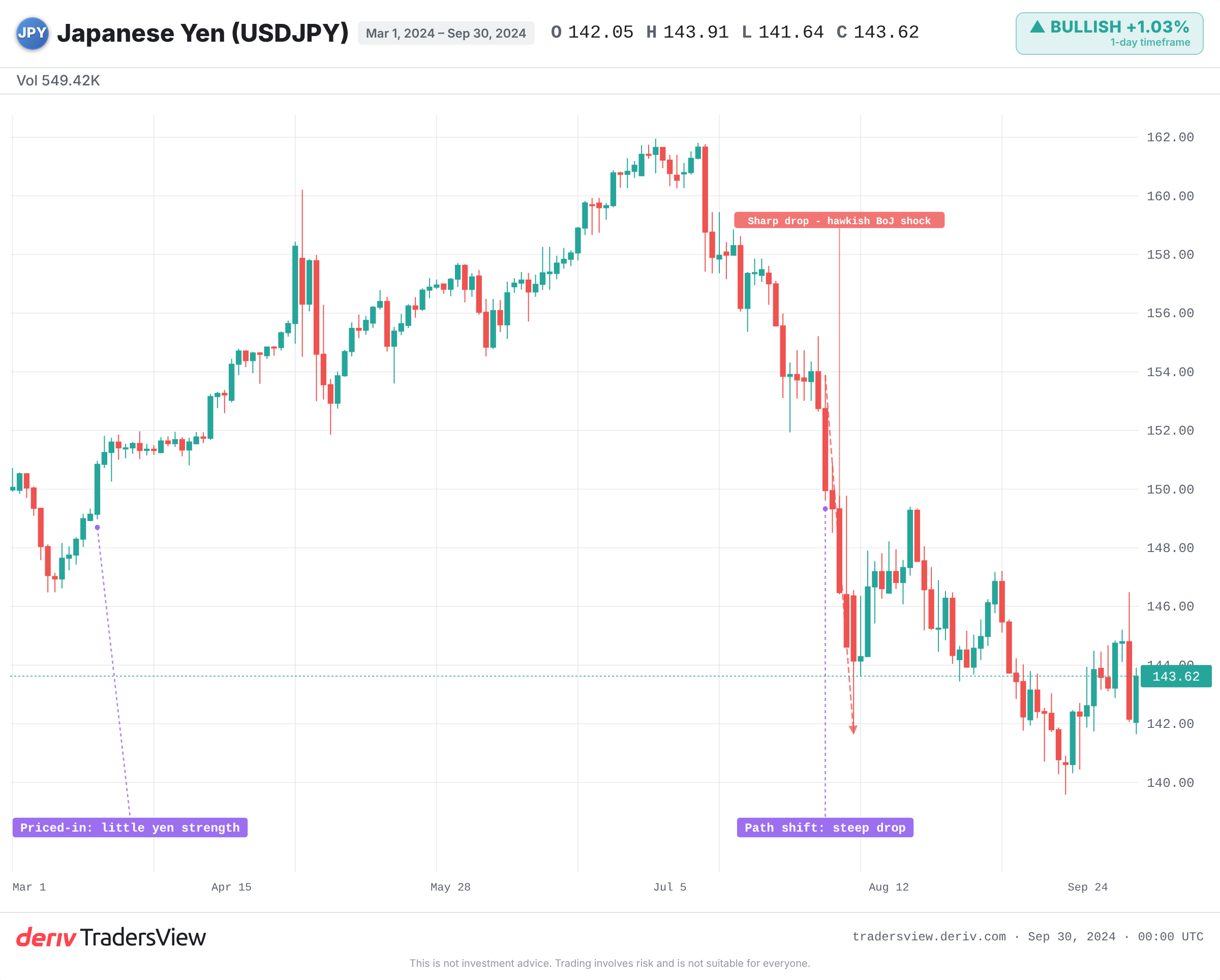
In March 2024 the BoJ ended negative rates, its first hike in 17 years. The yen weakened anyway. The move was fully priced, and the Fed's rate gap stayed wide, so nothing about the differential's path really changed.
In July 2024 the picture flipped. The BoJ hiked and signalled more tightening while the Fed leaned towards cuts. That shifted the whole path of the gap. The yen carry trade unwound violently, and USD/JPY fell steeply over the following weeks.
That unwind is worth understanding, because it is what turns a modest hike into a sharp fall. In a carry trade, investors borrow cheaply in yen and buy higher-yielding dollar assets, pocketing the rate gap. When the BoJ signals the gap will close, that trade stops paying. Traders buy back yen to repay the loans, and the rush to unwind drives USD/JPY down fast.
The lesson: a single hike does not reverse a trend. A change in the expected path of the gap does. June 2026's hike is the reminder in reverse: the BoJ moved, but USD/JPY stayed elevated because the broader differential held.
What to watch around the September decision
The evidence leans towards the guidance mattering more than the decision. A hike with a dovish, one-and-done tone could firm the yen far less than a hold paired with a hawkish signal on future tightening.
- The forward guidance, not just the hike or hold, on whether more tightening follows.
- Whether September odds climb or fade, which tells you how much is already priced.
- The Fed's path: a dovish Fed narrows the gap and amplifies any yen strength; a hawkish Fed offsets it.
- Political pressure from the Takaichi government, which a Bloomberg survey suggests could push the move towards December, with economists split.
- Intervention signs near the top of the range, towards the 2026 high. The Ministry of Finance does not publish a trigger level, so watch for verbal warnings and sudden yen spikes rather than a fixed line.
Dollar-yen carries real two-way risk here, and a single meeting rarely settles a trend on its own. Watch the gap between the two banks, and watch how much of the move is already in the price.
Frequently asked questions
It is the gap between the two central banks' policy rates and expected paths. The Fed currently pays much more than the BoJ, which favours holding dollar assets over yen and supports USD/JPY.
Traders borrow cheaply in low-yielding yen and invest in higher-yielding assets elsewhere. It profits while the rate gap stays wide, but can unwind fast when the BoJ hikes and the gap narrows, as it did in July 2024.
Yes. Japanese authorities can buy yen in the market to slow sharp moves, usually near the weaker end of the yen's range. Intervention tends to amplify moves that also fit the rate-differential story rather than fight it alone.
A Bloomberg survey shows economists split, with about half picking December. Political pressure from the Takaichi government is cited as a key reason a September move could slip to later in the year.