
China just gave itself a lever to unwind AI deals
China unwound Meta's $2bn Manus deal on AI-security grounds. The lost deal is tiny; the new regulatory precedent is the durable risk for traders.
By the Deriv desk · 12 August 2026 · 3 min read

China forced Meta to unwind its $2 billion Manus acquisition, but the lost deal is not the story. The new regulatory lever is.
The write-down is tiny for Meta. What matters is the precedent: Beijing used its foreign-investment security review to reverse a cross-border AI deal for the first time. That is a new rule, and rules reprice sectors long after a single deal is forgotten.
Why the market shrugged at a $2 billion unwind
$2 billion is a rounding error for Meta. For scale, Reality Labs lost more than $4.6 billion in a single quarter this year. The stock still trades far above its 2026 low and within reach of prior highs.
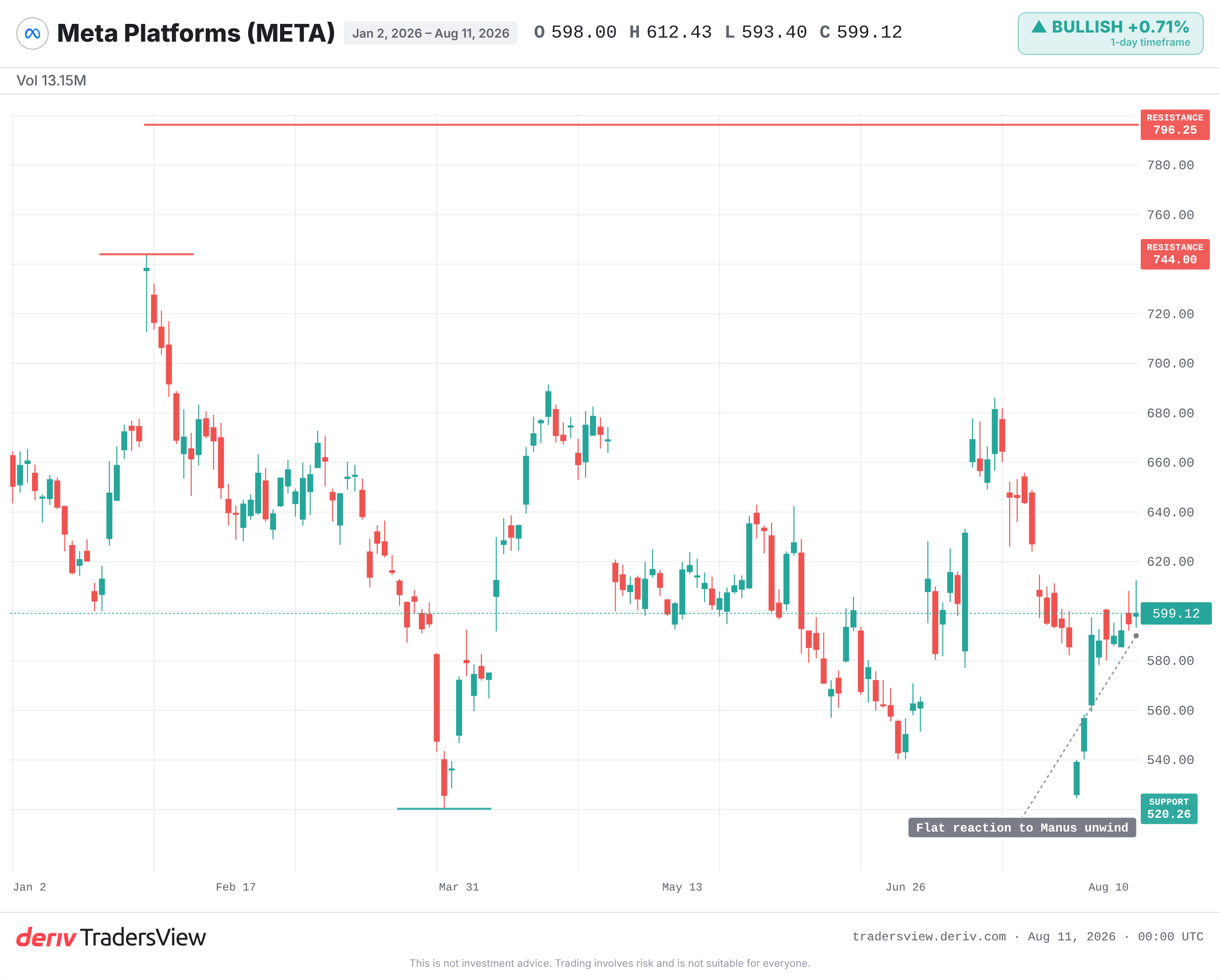
The flat tape is the clue that the market read this as immaterial to earnings. On the numbers alone, that read is fair. The Manus deal barely dents a quarter, let alone a valuation.
The precedent trade when a regulator does something for the first time
A single deal is priced on its own economics. A new regulatory power is priced across every company it could touch.
Beijing's NDRC did something it had not done before: it invoked AI-security grounds to unwind a US tech acquisition. Once a government asserts that authority, it tends to use it again. The first case is the cheapest to fight and the hardest to reverse.
The precedent, not the transaction, is the durable risk.
Why 'Singapore washing' no longer puts a deal out of reach
Manus had restructured offshore, a move critics called "Singapore washing": incorporate outside China and hope to escape its review. It did not work.
Regulators reached the deal anyway. For anyone modelling cross-border AI M&A, that closes a common escape route. Offshore structure is no longer a shield, and that changes how future deals get done and priced.
What history says about first-of-a-kind reviews
This pattern has form. In 2018, US CFIUS blocked Broadcom's bid for Qualcomm on national-security grounds, the first pre-announcement block of its kind. Security review then became a routine gate for tech M&A.
In 2020, China halted Ant Group's giant IPO days before listing and forced a restructuring. Separately, the US pushed ByteDance towards divesting TikTok's US operations.
In each case, the affected names carried a lasting policy-risk discount, regardless of the original deal economics. The lesson is not that Meta falls. It is that a new gate, once opened, stays open.
When the bearish case actually becomes right
The muted reaction may be correct. The bearish case only wins if the precedent widens.
Watch for whether other governments, including US CFIUS, cite this to review AI deals. Watch for any sign China extends reviews to other US firms' China-linked AI assets. Watch the August data-deletion deadline for a user or legal backlash. And watch Meta's price behaviour: a move well beyond its typical daily range on a related headline would show the market starting to price policy risk it currently ignores.
The evidence leans towards this being immaterial today and material as a template. A one-off is a rounding error. A pattern is a repricing. The gap between the two is where the risk sits, and it is not yet on the tape.
Frequently asked questions
The National Development and Reform Commission is a Chinese economic-planning body that runs a foreign-investment security review. It can approve, condition or, as with Meta's Manus deal, order a completed acquisition unwound on security grounds.
Not directly. If the deal is small relative to the company, the immediate financial hit can be negligible. The larger risk is a policy-risk discount that builds over time if reviews become a pattern.
It refers to restructuring a China-origin company through an offshore base, such as Singapore, to try to sit outside Chinese regulatory reach. The Manus case showed this restructuring did not prevent Beijing's review.
CFIUS is the US committee that screens foreign investment for national-security risk and has blocked deals like Broadcom-Qualcomm. Both regimes let a government gate or reverse cross-border tech deals regardless of the deal's economics.