
Central banks bought gold for 20 months, so why did it fall?
China's central bank bought gold for a 20th month, yet gold fell on the day. Structural demand builds a floor while daily flows set the price.
By the Deriv desk · 7 July 2026 · 4 min read

Structural demand and daily price move on two different clocks. A patient buyer can build a floor under an asset while the price still drops on the day.
China's central bank added to its gold reserves in June 2026. That was the 20th month in a row. Yet gold traded lower on the day the news landed. Both facts are true, and understanding why is the whole lesson.
Why steady central-bank buying does not move the price today
The People's Bank of China accumulates gold slowly and deliberately. It is diversifying its reserves, not betting on next week's candle. This is price-insensitive demand: it buys whether gold is up or down.
That kind of buyer is the ultimate patient hand. But the daily tape is set by fast money. Speculators and exchange-traded funds move far more volume in a single session than a central bank adds in a month.
So the structural bid builds a floor over years, while tactical flows set the price today. On the day of the June report, the sellers were louder. That tells you nothing about the longer thesis.
What actually puts a floor under gold
Think of a reservoir filling from a slow, steady stream. Day to day, the water level swings with rain and evaporation. But the stream never stops, and over time the base level rises.
Central-bank gold buying is that stream. It is not fast enough to catch a falling price on any given session. It is persistent enough to change where the price can settle over years.
The 2022 to 2023 period showed this clearly. The Federal Reserve raised interest rates hard, which normally pressures gold. Instead gold held firm and pushed to record highs. The World Gold Council reported central banks bought over 1,000 tonnes in 2022, and that structural bid is widely credited as the floor.
Does slow official buying mean gold goes up?
Not on its own, and not on your timeframe. This is where the two clocks matter most.
When China resumed disclosed buying in late 2018, gold broke out of a multi-year range through 2019 and 2020. But the buying was the backdrop, not the trigger. Falling real yields did the heavy lifting.
Slow structural demand is a long-term thesis, not a timing tool. Reading "central banks are buying" as a signal to buy today confuses the reservoir's base level with tomorrow's weather.
The case against reading this as bullish
The honest counter-argument is straightforward. Central-bank buying is low-volume next to daily gold turnover, and it plainly failed to stop gold falling on the report day.
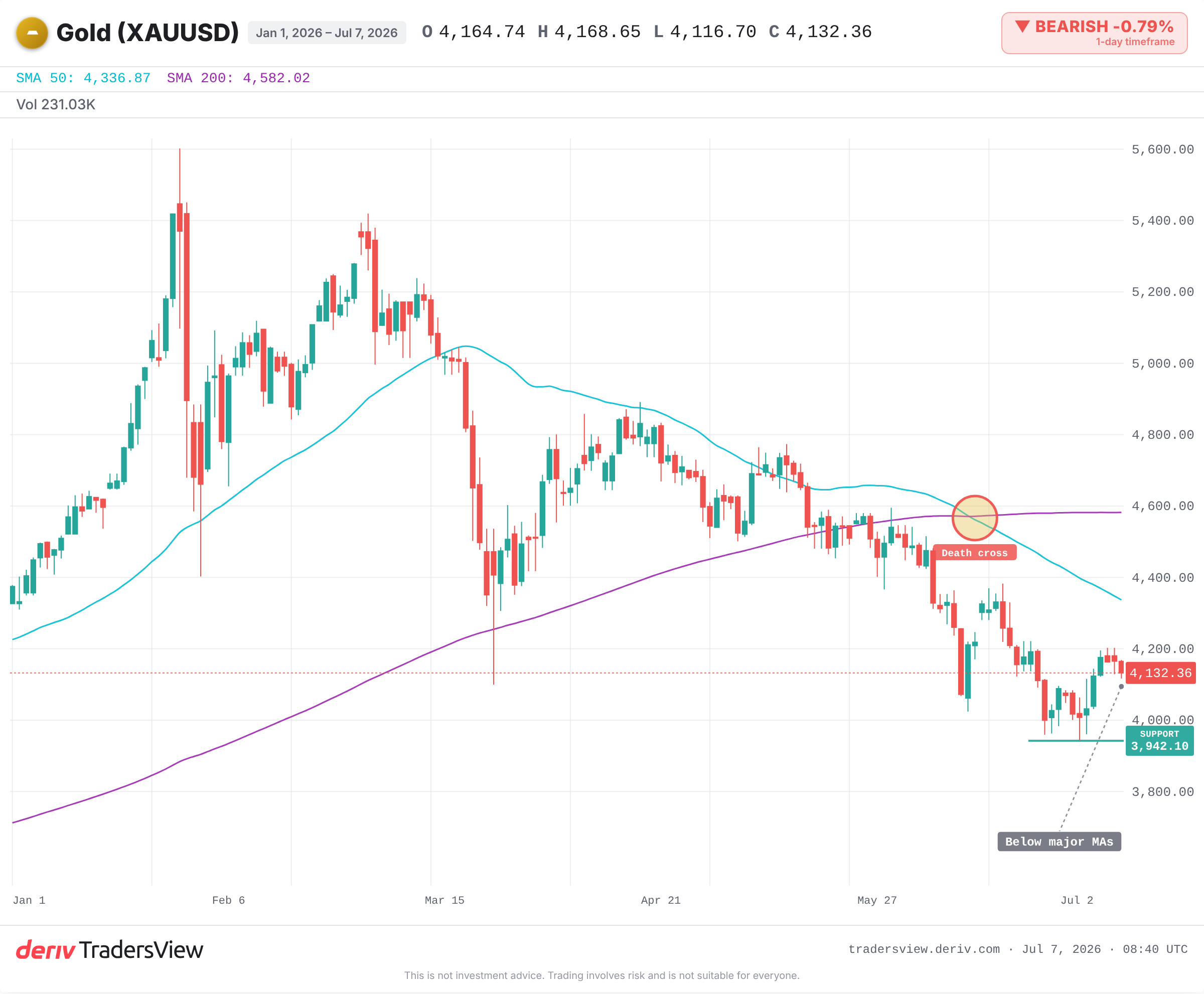
If ETF and speculative money exits faster than the PBoC accumulates, the floor can sit well below current prices. Gold is trading below its major moving averages. A rising US dollar or climbing real yields would pressure it regardless of official demand.
The structural read weakens if China pauses the streak. It did pause in May 2024, and gold wobbled short term before the uptrend resumed. A pause is not a break, but the market often sells first and checks later.
What to watch next
- Whether the PBoC extends or pauses the streak in the next monthly reserve update.
- The US dollar and US real yields: rising versions of either pressure gold whatever central banks do.
- ETF and speculative positioning, which moves far faster than official accumulation.
- Whether gold holds near-term support or breaks below it.
The takeaway is not that gold must rise. It is that a slow buyer and a fast tape can pull in opposite directions at once, and neither one cancels the other. Trading is risky; a structural bid is a reason to respect the floor, never a reason to ignore the trend.
Frequently asked questions
The People's Bank of China reported holdings of 75.44 million fine troy ounces at end-June 2026, up from 74.96 million in May. The reported value fell to about $303.72 billion as gold prices moved lower.
Mainly to diversify reserves away from any single currency, especially the US dollar. It is a slow, strategic reserve-management decision rather than a trade on short-term price direction.
It can trigger short-term selling, as happened when China paused in May 2024. But a pause is not a reversal, and the longer-term uptrend resumed afterwards. Markets often sell the headline first.
Fast flows dominate the daily tape: speculative positioning, ETF buying and selling, the US dollar and real yields. These move far more volume in a session than a central bank adds in a month.