
Buying Apple before earnings bets on numbers you can't see
Buying a stock in the days before scheduled results is a bet placed ahead of new information. A high price and a bullish analyst target tell you nothing
By the Deriv desk · 21 July 2026 · 4 min read

Buying a stock in the days before scheduled results is a bet placed ahead of new information. A high price and a bullish analyst target tell you nothing about which way the surprise will break.
Apple gives the clearest live example. It has retaken the title of the world's most valuable company and trades just below its all-time high, heading into its fiscal Q3 2026 report on July 30, 2026. The setup looks strong. That is exactly what makes it risky.
Why a scheduled earnings date changes the game
Most days, a stock price reflects information the market already has. An earnings date breaks that. On July 30, Apple releases numbers no one outside the company has seen: revenue, profit, and the guidance that shapes the next quarter.
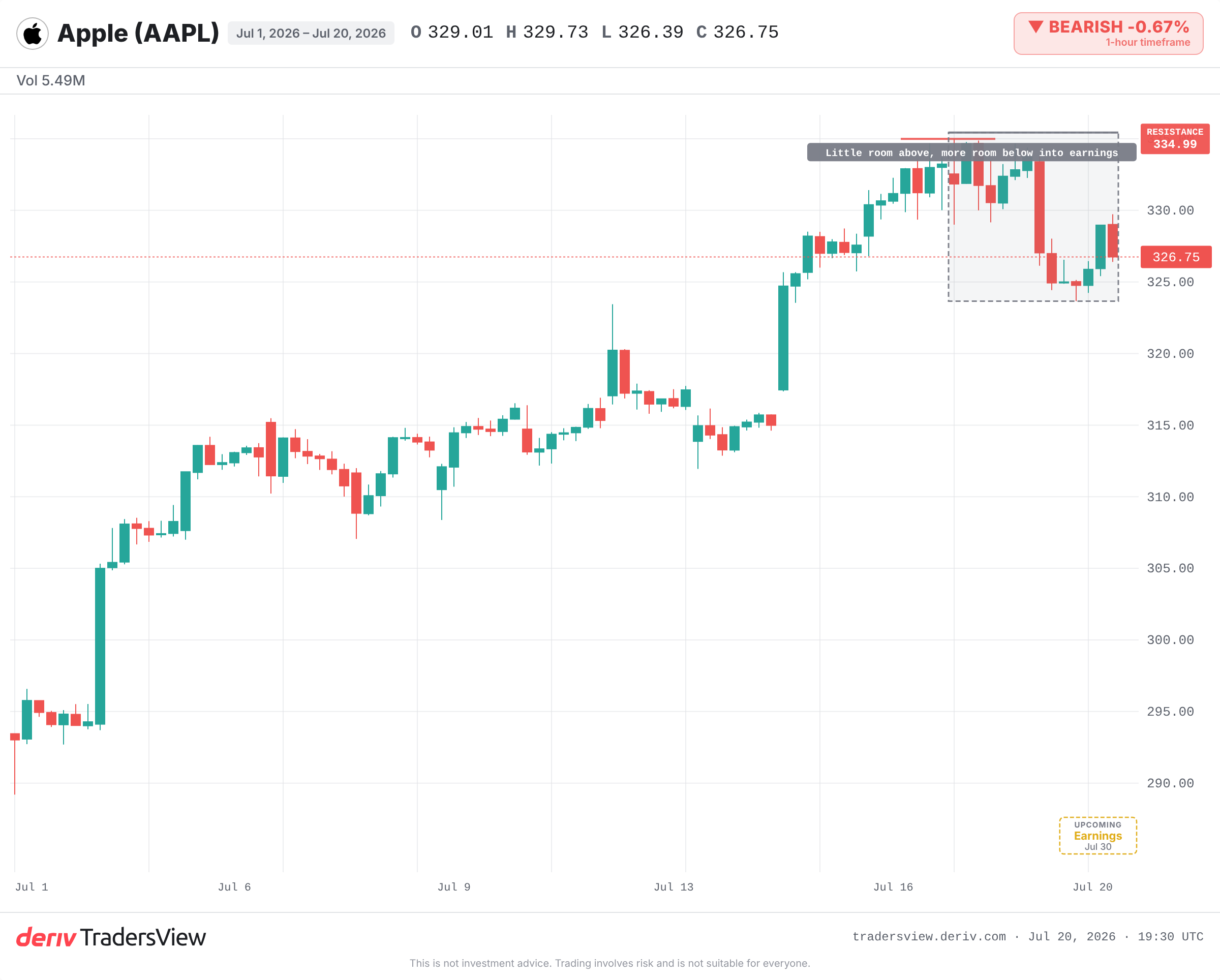
Buy the day before, and you are paying today's price for tomorrow's unknown. The optimism is already in the price. The facts are not.
A catalyst is not a direction. It is a moment when the market learns something and reprices fast.
Why near the all-time high is where earnings get dangerous
The closer a stock sits to its record, the more good news it takes just to hold the line. Apple is within a few per cent of its all-time high. That leaves little room above and plenty below.
A high price compresses the reward from a beat and widens the fall from a miss. Across mega-cap earnings from 2023 to 2025, stocks at or near records repeatedly saw large post-earnings gaps in both directions. Nvidia, Meta and Netflix all showed it.
This is not an Apple problem. It is what happens when expectations are already generous.
When the analyst is buying and the legend is selling
The story has two smart parties on opposite sides. Citi analyst Asiya Merchant raised her Apple price target to $365, citing the iPhone 18 as a catalyst. That is the bull case.
On the other side, Berkshire Hathaway, Apple's most famous long-term holder, has been trimming its stake even as its broader portfolio rallies. The crowd chases the upgrade. The legend heads for the exit.
When two informed parties disagree right before a catalyst, that disagreement is the signal, not the noise. It means the outcome is genuinely uncertain, and the price reflects a bet, not a fact.
Why the surprise usually hides in guidance
The biggest pre-earnings shocks rarely come from the headline number. They come from what the company says next.
In early 2019, Apple pre-announced a rare revenue warning on weak iPhone demand in China. Shares gapped down hard. In August 2024, Apple beat expectations, but soft iPhone revenue and cautious guidance drew scrutiny, and the stock swung sharply into a volatile tape.
China demand and Services margins are where Apple has surprised before. A beat on paper can still trigger a sell-off if the outlook disappoints.
What to watch around July 30
The evidence leans towards caution, not because Apple is weak, but because the price already assumes strength.
- The revenue and profit print against what the market expects.
- Guidance on iPhone 18 demand, the basis of Citi's bull case.
- The China revenue trend, historically Apple's biggest downside risk.
- Whether the price can clear and hold its all-time high, or gets rejected there.
One more mechanical point. Expected volatility tends to run high before results, then collapse after the print. That drop can hurt even a correct directional bet. Buying before a catalyst is not wrong. Mistaking a strong-looking setup for a known outcome is.
Frequently asked questions
That depends on your own risk tolerance, not on how strong the stock looks. Holding through results exposes you to a large gap in either direction, since the outcome and guidance are unknown until the print. Some traders reduce exposure before the event to avoid that uncertainty.
Expected volatility tends to rise before a scheduled report and fall sharply once the numbers are out. This drop is called IV crush. It can erode the value of options positions even when the trader guessed the price direction correctly.
A beat only matters relative to expectations. If the price already assumes strong results, or if forward guidance disappoints, the stock can fall despite better-than-expected numbers. Guidance and demand signals often move the price more than the headline figure.
No. A price target is one firm's estimate of fair value over a set horizon, not a forecast of the next move. Targets often disagree, and a fresh bullish target does not tell you how the market will react to new numbers.