
Berkshire's $31bn Alphabet bet and what size tells you
Berkshire built a ~$31bn Alphabet stake in under a year. What a concentrated bet from a disciplined investor tells you, and why copying it late is a different trade.
By the Deriv desk · 13 July 2026 · 4 min read

When a disciplined investor builds a huge, concentrated position, the size is the message. It says the smart money sees a durable, decade-long edge, but the same concentration that can define a decade also magnifies the risk.
Berkshire Hathaway built a roughly $31 billion stake in Alphabet from a standing start in under a year. Its 13F filing, covering holdings as of 31 March 2026, shows Alphabet is now the group's third-largest equity holding. That puts it ahead of Coca-Cola, a position Buffett held for over three decades.

Why the size of the position is the real signal
A small stake is a maybe. A stake this large is a statement. Alphabet now sits at more than 9% of Berkshire's entire investment portfolio, built from a modest opening buy the year before.
Berkshire does not trade around positions. It buys businesses it wants to own for years. So a concentrated bet on one name is not a punt on the next quarter. It reflects a view that the underlying business has a lasting edge that will compound.
The Apple parallel, and why concentration cuts both ways
The comparison writes itself. Berkshire began buying Apple in early 2016 and scaled it fast. At its peak, Apple was about half of the disclosed equity portfolio.
That bet became the most profitable equity investment in Berkshire's history. It defined a decade for the firm. But the same concentration that produced those gains left Berkshire heavily exposed to a single company.
Concentration is conviction and risk in one move. When the thesis is right, size turns a good idea into a defining one. When it is wrong, size turns a mistake into a serious one. The Japanese trading-house stakes from 2020 showed the upside of an out-of-character Berkshire bet. Coca-Cola showed the other edge: a legendary buy-and-hold can still deliver years of dead money, as it did through the long stagnation from the late 1990s.
Why copying the trade months later is not the same trade
A 13F is backward-looking. This one reflects holdings as of March, disclosed in July.
The price you can buy at today is not the price Berkshire paid. As of 10 July 2026, Alphabet trades around $355, only about 12% below its all-time high near $404. Berkshire built much of this position lower and earlier.
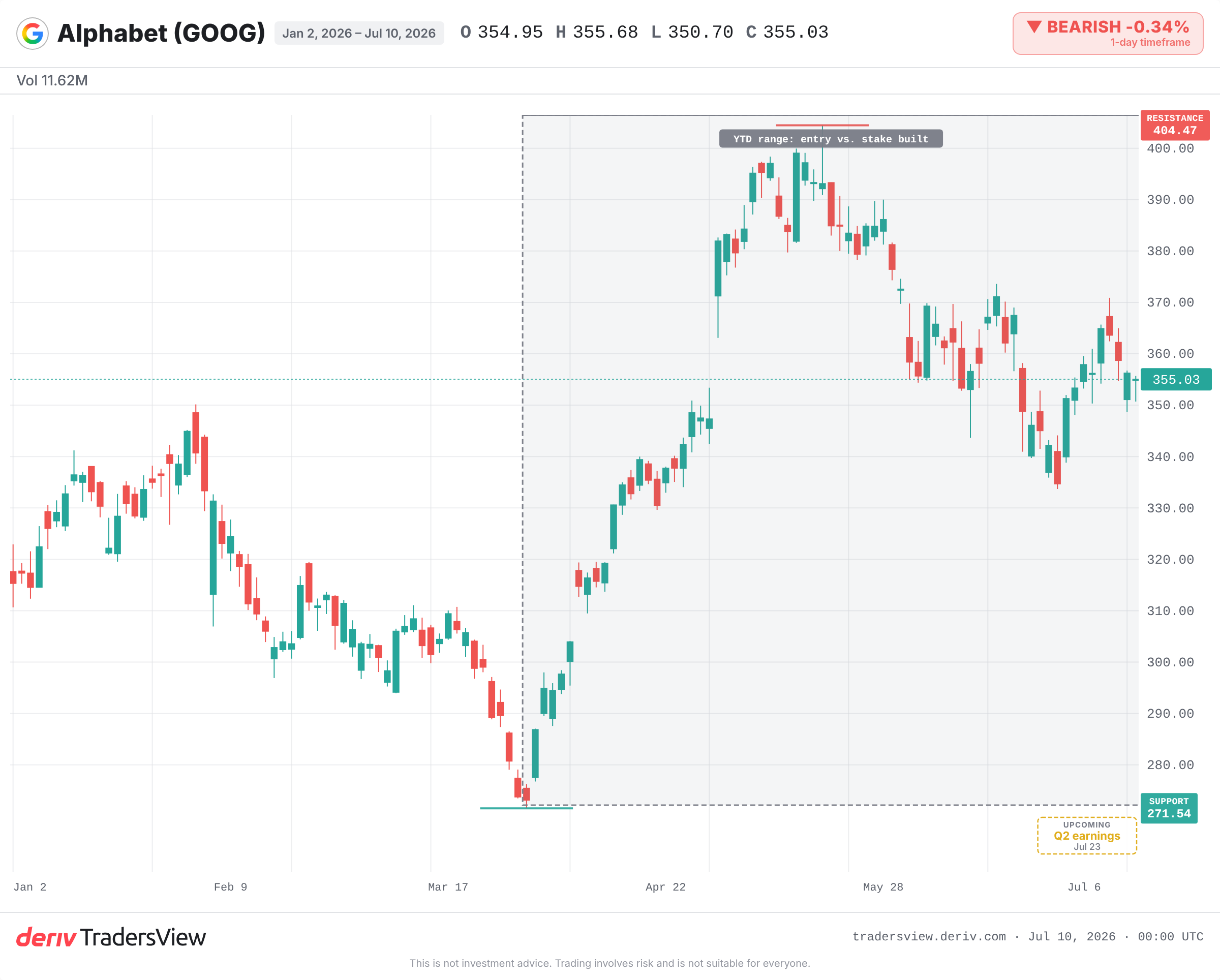
Buying a legendary investor's biggest holding after the filing is public is a different trade with a different entry. You are late, and you are paying for information everyone now shares.
The risks that would prove the bet wrong
Alphabet carries real threats to the thesis. Antitrust rulings could force changes to how Google runs search and advertising. AI itself could erode the core search-ad business that generates most of the profit.
There is also a question mark over the buyer. Reporting frames this as incoming chief Greg Abel setting a direction, not just a continuation of Buffett's playbook. That matters, because a new hand at the wheel changes how much the position tells you.
What to watch from here
- The next 13F filing: was the stake increased, held, or trimmed? A cut would undercut the whole conviction story.
- Antitrust remedies affecting Google's search and ad business.
- Cloud and AI segment growth in quarterly earnings, the figures that justify or sink the thesis.
- Price behaviour around the all-time high near $404 (resistance) and the year-to-date low near $271 (support).
The evidence leans towards reading this as genuine long-term conviction from a disciplined buyer. That is useful information. It is not a licence to buy at a higher price with none of the edge that made the original bet work.
Frequently asked questions
A 13F is a quarterly report US institutional managers must file, listing their equity holdings. It is disclosed weeks after the quarter ends, so it shows what a fund owned in the past, not what it holds today.
Apple grew to about 50% of Berkshire's disclosed equity portfolio at its peak, making it by far the firm's largest single holding and its most profitable equity investment.
Concentration means a large share of returns depends on one name. If that company faces a shock, such as a regulatory ruling or an earnings miss, the impact on the overall portfolio is far larger than with a diversified position.
Alphabet's core appeal has been growth in search, advertising, and cloud rather than income. Investors generally hold it for capital appreciation rather than for a yield comparable to a consumer-staples name like Coca-Cola.