
Apple is swapping its CEO. Why the stock barely flinches
Apple's Cook-to-Ternus handover is a $4 trillion event built for continuity. Markets price the surprise, not the size of a headline.
By the Deriv desk · 24 July 2026 · 3 min read

Markets price the change in what they expected, not the size of the headline. Apple's Tim Cook is stepping down in September after nearly 15 years, handing control to hardware chief John Ternus. It is one of the largest CEO handovers in corporate history. It may also be one of the quietest, and that shows how stocks actually move.
Why a huge event can be a market non-event
A stock reacts to surprise, not scale. What matters is how much an event shifts the future cash flows investors already have penned in. A CEO change this size sounds seismic. But it was long-planned, heavily signalled, and built for continuity.

Cook stays on as executive chairman. The message is stable strategy, stable capital returns, stable operational discipline. When a handover is designed to change expectations as little as possible, the price has little to re-rate.
The Jobs-to-Cook handover shows the pattern
This has happened before. In August 2011, Steve Jobs resigned and Cook took over. The move had been telegraphed through Jobs's medical leaves for months.
Shares dipped only modestly and recovered, because the product roadmap and strategy stayed intact. Apple then went on to become the most valuable company in the world. The lesson holds: orderly, pre-announced transitions tend to produce muted price reactions. Sudden, unexplained exits produce sharp gaps, because only those force investors to rethink future earnings.
Where Apple sits going into the change
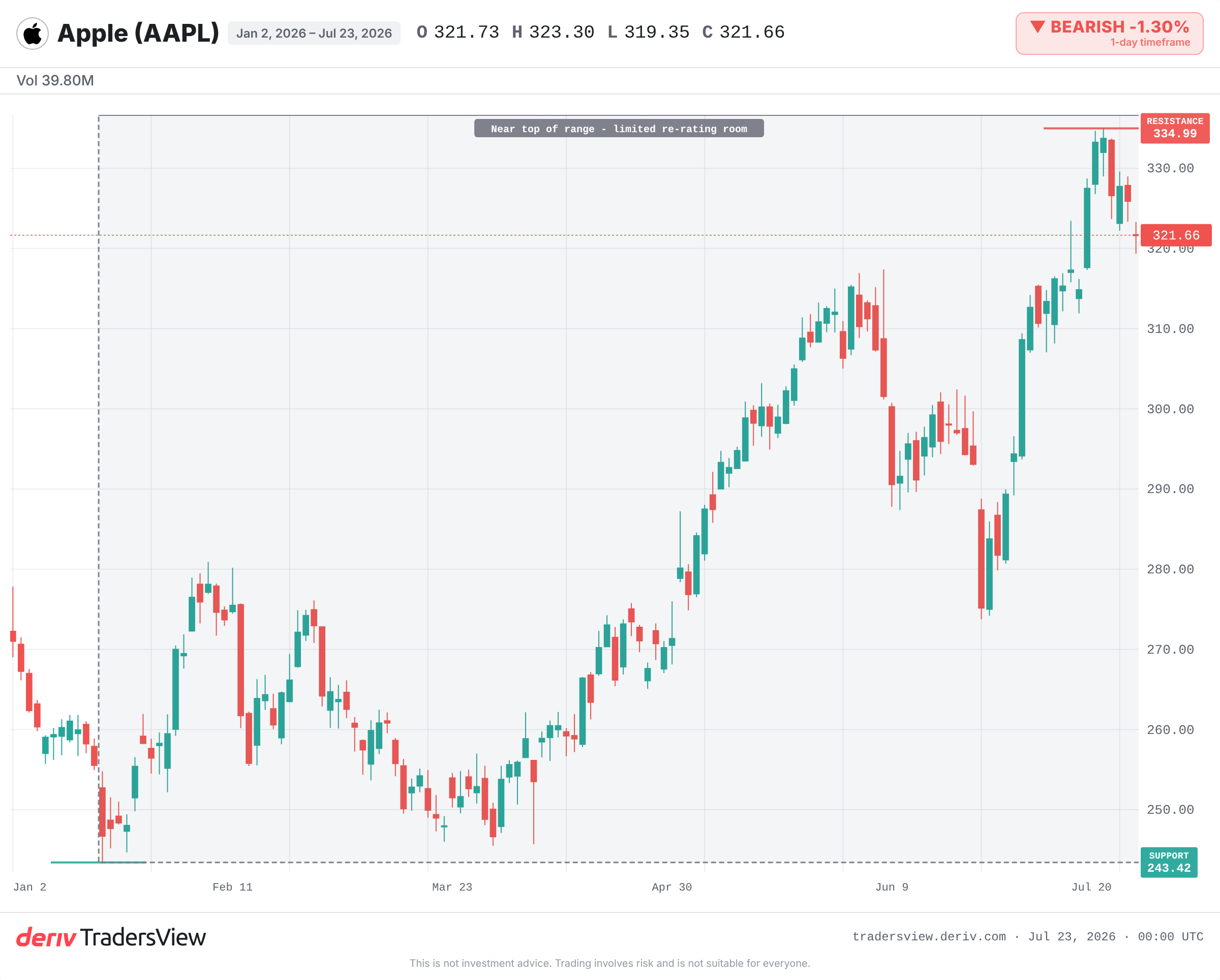
Context matters for how much room a stock has to absorb news. Apple trades near the top of its yearly range and close to its record high set in 2026. It recently reclaimed the title of most valuable company from Nvidia.
A stock sitting near a record has already priced in a lot of optimism. That cuts both ways. Good news is expected, so it does less. Any real disappointment has more distance to fall.
The case for caution on continuity
Continuity is the reassuring read. It may also be the risk. Ternus is a hardware operator, not the supply-chain and operations master Cook was.
Apple already faces a trimmed Berkshire stake, an ongoing lawsuit, and open questions about its position in AI. The bearish view would be confirmed if Ternus hints at any change to the capital-return programme, or if the stock sells off on the transition rather than shrugging it off. That would reveal expectations were more fragile than the calm framing assumes.
What to watch after the handover
The evidence leans towards a muted reaction, in line with orderly successions before it. The signals that would change that read are concrete.
- Whether shares hold near the record zone or drift back towards the year's midpoint once the news digests.
- Any change to Apple's capital-return programme or guidance around the handover.
- Berkshire Hathaway's next disclosed Apple position: further trimming would signal a large holder's doubt.
- Ternus's first public strategy comments: continuity language, or a hint of a pivot.
The takeaway outlasts this one event. Before you react to a big headline, ask what it actually changes about the numbers. A shock is only a shock if it moves the future.
Frequently asked questions
It means investors already expected the news, so it is reflected in the current price. When an event is priced in, the actual announcement moves the stock little, because it changes nothing about the future cash flows people had already assumed.
Because the good news was expected and already in the price. If a result merely meets high expectations, there is no upside surprise, and any small disappointment can trigger selling, especially when a stock sits near a record.
Ternus is Apple's hardware chief, set to take over as CEO in September when Tim Cook steps down after nearly 15 years. Cook is expected to remain as executive chairman.
When Steve Jobs resigned in August 2011 and Cook took over, shares dipped only modestly and recovered. The transition had been telegraphed for months, so the strategy and product roadmap stayed intact.