
Amazon's AI bet is soaring. So why is the stock stuck?
Amazon trades below its record while its Anthropic stake compounds fast. Why valuations price the future, and why the market still punishes the spending.
By the Deriv desk · 20 July 2026 · 4 min read

Amazon is stuck below its record while one bet inside it soars because a share price pays for proven future cash, not a gain still sitting on paper.
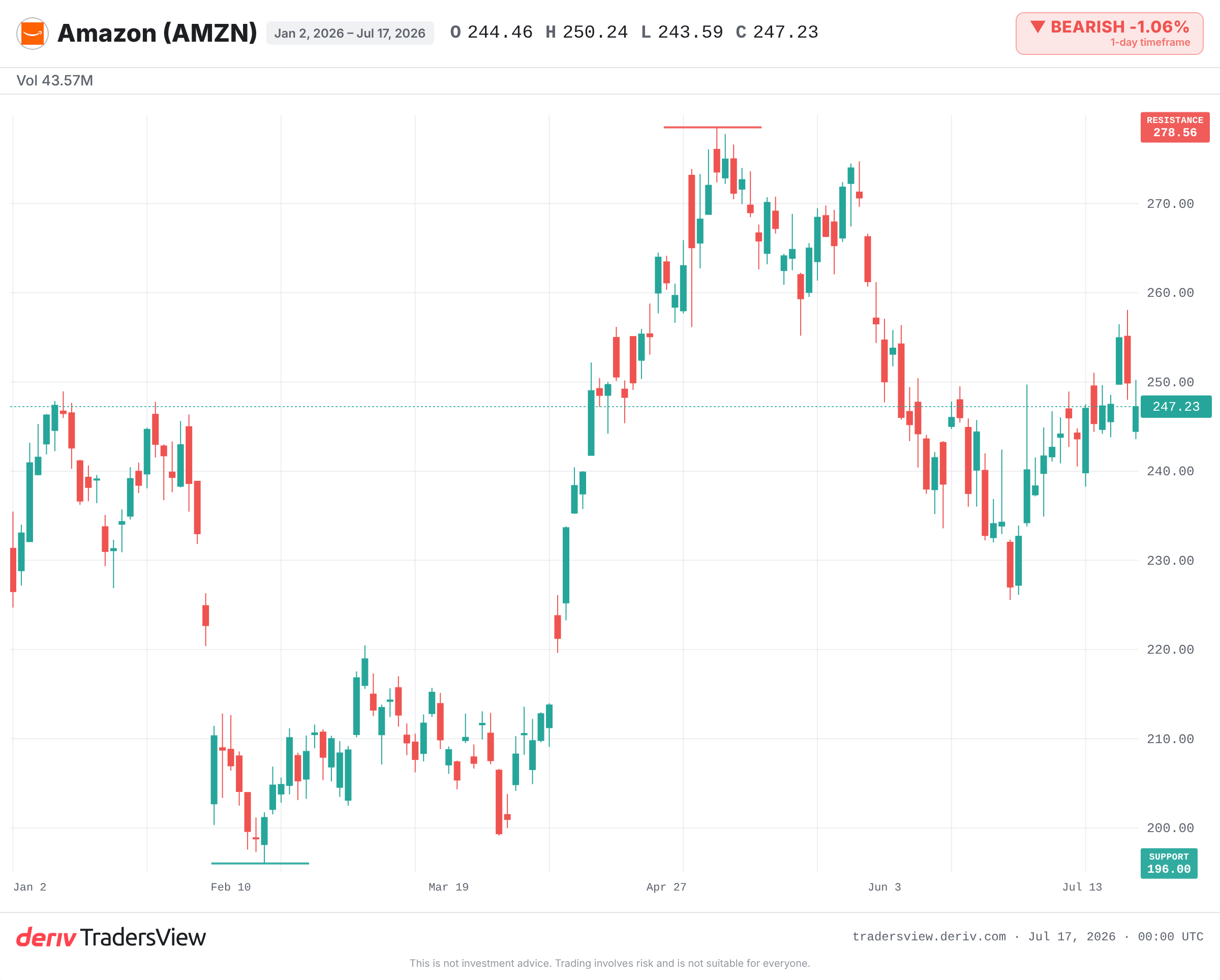
The stock trades in the mid-240s, well shy of its high near $279. Yet the buzz is all about one holding: an AWS-backed stake in the AI lab Anthropic, said to be compounding at extraordinary speed. So why is the price stuck? Because investors are torn between a fast-growing asset and the vast spending that funds it.
Why a valuation moves on the future, not the present
A share price is a bet on future returns. When a company owns something growing at an unusual rate, the market tries to price that growth in now, before the cash arrives.
That is the pull on Amazon today. Reporting from Seeking Alpha says Anthropic's annualised revenue run rate leapt from about $9bn at the end of 2025 to more than $30bn in 2026. A holding tripling in revenue in a year is exactly the kind of asset that can reprice a giant. The faster a piece compounds, the more of tomorrow's value gets dragged into today's price.
Why the market still punishes the spending behind it
The same logic cuts the other way. Amazon has detailed around $200bn in AI-related capital spending. That money has yet to prove its payoff.
So the stock has fallen to a decade-low multiple near 29 times earnings, per Yahoo Finance coverage. The market cheers a rising stake and docks the bill that pays for it. Both reactions come from the same rule: value follows proven future returns, and a huge outlay with no return in sight reads as risk, not promise.
The paper gain is not yet a booked gain
The bullish read gets ahead of itself here. It leans on an unconfirmed report of a $1.2 trillion Anthropic IPO. Reuters and other coverage describe more cautious valuation and timeline details.
A paper gain is not money Amazon has booked. It becomes real only through an event Amazon actually records, an IPO or a consolidation, at a price the market accepts. Until then it lifts sentiment and nothing else. An unrealised gain flatters the story long before it touches the accounts.
Execution risk is live, too. A recent AWS billing bug overcharged some customers by billions, a reminder that things break even as AWS sales grew about 24% year over year.
What history says about betting on the future
The pattern has played out before. In 1999 Amazon itself carried an extreme valuation on future growth, then fell roughly 90% from its peak before recovering over years. In 2022 investors punished heavy capex at Amazon and Meta, then rewarded both through 2023 and 2024 as the spending converted to margin.
The lesson is not that spending always pays off. It is that the market reprices constantly as proof arrives or fails to.
What to watch from here
- Whether an Anthropic listing materialises anywhere near the reported scale, and on what timeline.
- Confirmation of Anthropic's actual revenue run rate against the reported jump.
- Early signs the $200bn capex is converting to margin, or evidence it is not.
- Whether AWS growth holds near the reported 24% year over year.
- The all-time high near $279 as resistance, and the prior lows near $196 as support.
The evidence leans towards patience over the paper number. The compounding asset is real, but the gain is contingent, and the spending is certain. Watch the capex turn into returns before the story turns into a price.
Frequently asked questions
A gain becomes realised only through an event the company records, such as the startup listing publicly, being acquired, or a funding round at a marked-up price. Until then, any increase in value is an unrealised paper figure that does not hit reported earnings.
A run rate annualises recent performance, taking a short period's revenue and projecting it across a full year. It signals momentum but assumes current pace holds, so a fast-rising run rate can overstate durable revenue if growth slows.
Heavy capital spending pulls forward cash that could otherwise return to shareholders, and its payoff is uncertain. Markets tend to discount the stock until the spending converts into higher margins or growth, then reprice once proof arrives.
Not on its own. A low multiple can reflect genuine value or investor doubt about future earnings. It only signals cheapness if the underlying business keeps growing, which is precisely what the market is testing here.