
Amazon fires 30,000 and spends $220bn
Amazon is cutting 30,000 jobs while guiding to nearly $220B of 2026 AI spend. Why the combination signals a capital shift, not distress, and what to watch.
By the Deriv desk · 4 August 2026 · 3 min read

When a company fires thousands and spends billions in the same year, the layoffs are rarely the story. The capital going out the other door is.
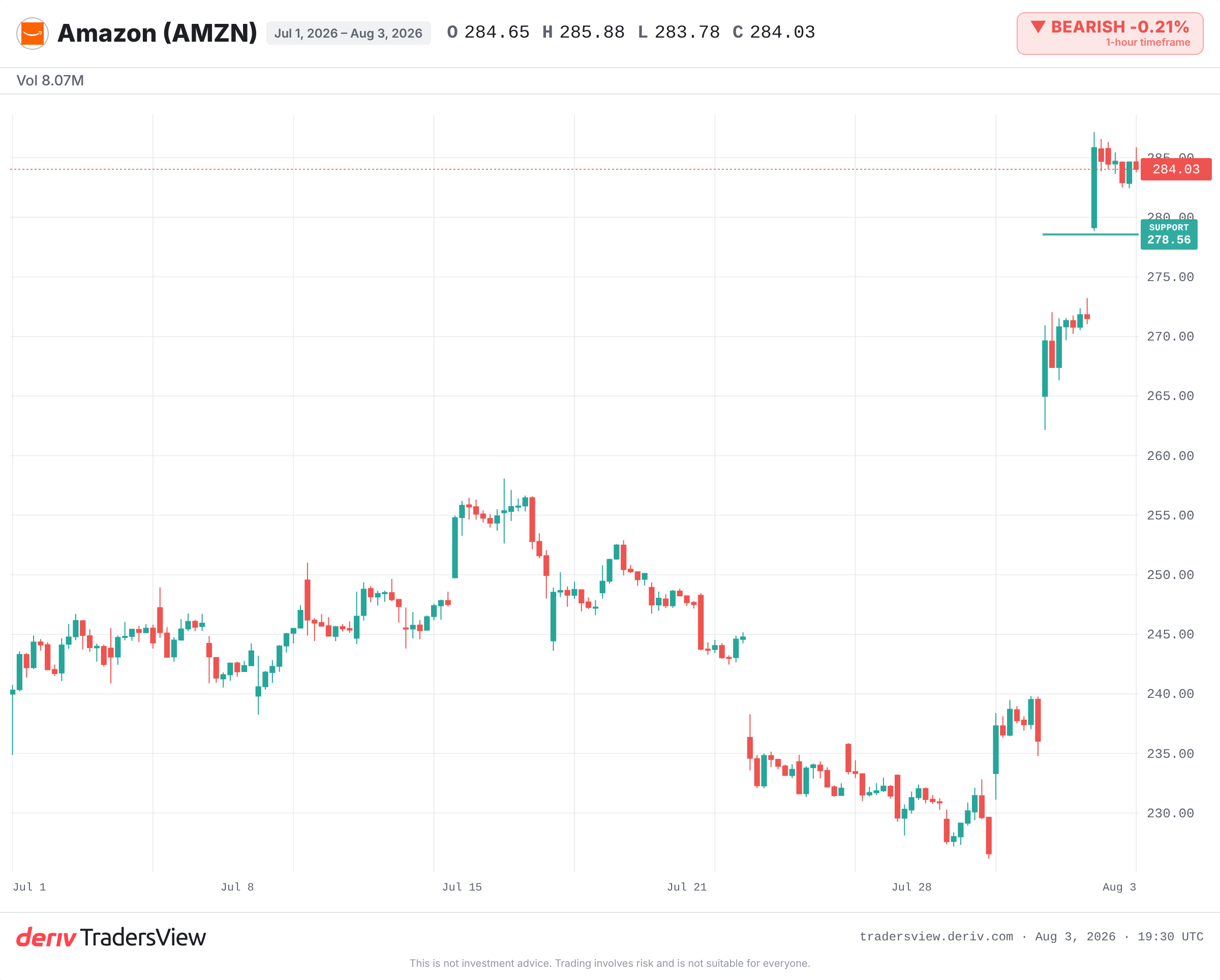
Amazon is cutting roughly 16,000 jobs now, about 30,000 since October 2025. At the same time, it is guiding towards nearly $220 billion of capital spending in 2026, most of it AI and data centres. The market read this as offensive, not defensive. The stock pushed above its prior all-time high.
Why firing people and spending more can go together
The instinct is simple: layoffs mean trouble. Sometimes they do. Here they signal something else.

Chief executive Andy Jassy said the cuts are not driven by finances. His framing points at culture and management layers, not survival. Meanwhile the company plans to keep hiring in AI. Capital is being moved, not saved. Labour out of overhead, capital into compute.
The harder read is not whether a firm is cutting. It is where the freed-up money lands.
The split-screen: winning and bleeding cash at once
Amazon's last report showed two things at once. AWS carried a large contracted backlog and sold-out capacity stretching into 2027. That is the demand side of the bet.
The other side is less comfortable. Free cash flow turned negative. Debt rose sharply as the buildout ramped. So a reader faces a genuine tension: record cloud demand and a heavy pre-sold order book on one side, weaker cash generation and rising leverage on the other.
Both pictures are true. The question is which one the next few quarters confirm.
Has this playbook worked before?
There is a recent template. In 2022 and 2023, Meta cut around 21,000 jobs during its self-styled year of efficiency while raising AI and data-centre spending. Margins widened and the stock recovered over the following year. Investors rewarded the swap from headcount to compute.
The same 2023 cloud cycle saw Microsoft, Alphabet and Amazon all lift AI capex while trimming non-AI roles. Cloud growth reaccelerated through 2024 and 2025. Free cash flow compressed as buildout costs rose.
There is an older, less flattering case. In the late 1990s, telecoms poured capital into fibre ahead of demand and called it future-proofing. Much of that capacity sat idle for years. Heavy pre-demand spending can run ahead of the revenue meant to justify it.
What would turn reallocation into a bad bet
Jassy's case rests on long-lived assets. He argues data centres monetise over 30-plus years, and that a large contracted backlog de-risks the spend. If AWS keeps growing into that capacity, the maths works.
If it does not, the picture inverts. Committed capex becomes a fixed cost against a more leveraged balance sheet. Then reallocation starts to look like a bet that has to pay off on schedule.
The evidence leans towards offence for now, because demand and backlog are real. But this is capital at risk, and the cash-flow print is the warning light. Watch AWS growth, whether negative free cash flow reverses, and whether the layoffs ever spread into revenue-generating divisions rather than overhead. That last one would change the story.
Frequently asked questions
Not always. Cuts can signal distress, but they can also free up capital for a new priority. The clearer read is where the saved money is being redeployed. When a firm cuts staff and raises spending at the same time, the cuts are often a reallocation, not a survival move.
Capital expenditure, or capex, is money a company spends on long-lived assets like data centres and equipment. Heavy AI capex can support future growth, but it also weighs on free cash flow and can raise debt while it is being built out.
Fast-growing firms can spend more on infrastructure than they generate in cash during a buildout phase. Depreciation and construction costs rise ahead of the revenue that will eventually justify them, which pushes free cash flow lower or negative for a period.
A backlog is the value of committed customer contracts a provider has yet to fulfil. A large cloud backlog suggests demand is already secured, which can help justify heavy upfront spending on capacity, provided that demand converts to revenue on schedule.